Part V · 3 — Hardware
The physical substrate. Here the concepts from Part I (GPU, HBM, interconnect) become numbers, models, and prices — what to buy, what to rent, and the bottleneck that defines everything: memory.
🎨 Figure
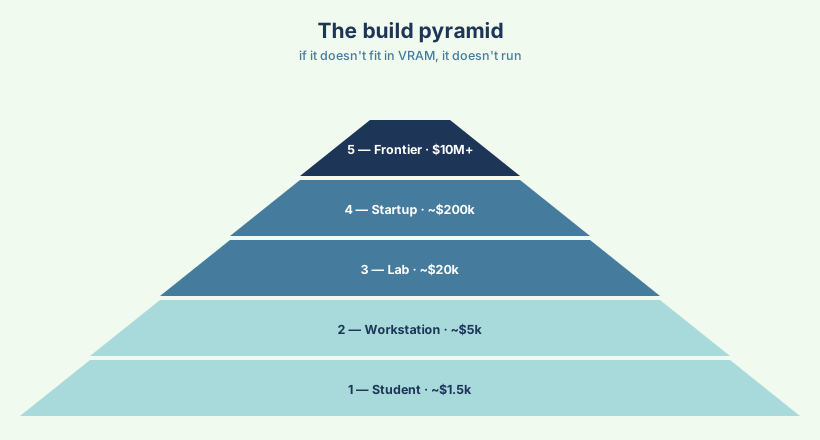
F-V.3— The build pyramid. Brief: a 5-level pyramid (student → frontier company), each level with a GPU icon and a cost band; alongside, the rule "if it doesn't fit in VRAM, it doesn't run". Compendium palette.
3.1 Why GPUs
Neural networks essentially do matrix multiplication. An H100 has ~16,000 CUDA cores + 500+ Tensor Cores → ~2,000 TFLOPS FP16 (≈2,000× a CPU in massive parallelism). The CPU is optimized for sequential logic; the GPU, for parallelism.
3.2 VRAM — the bottleneck that defines everything
Rule: if the model doesn't fit in VRAM, it doesn't run.
| Model | FP16 | INT8 | INT4 | Where it fits (INT4) |
|---|---|---|---|---|
| Llama 3.2 3B | 7 GB | 4 GB | 2.5 GB | any modern GPU |
| Qwen2.5-Coder 7B | 15 GB | 8 GB | 5 GB | RTX 3060 12GB |
| Qwen2.5-Coder 32B | 66 GB | 34 GB | 20 GB | RTX 3090/4090 24GB |
| Llama 3.1 70B | 140 GB | 72 GB | 40 GB | 2× RTX 3090 / A100 40GB |
| DeepSeek-V3 671B MoE | 1.3 TB | 670 GB | 350 GB | 8× H100 / 4× B200 |
Training consumes ~16–20 bytes/parameter (full fine-tune). QLoRA (INT4 + LoRA FP16) fits a 70B in ~48GB. With an RTX 4090/5090 (24–32GB): QLoRA up to ~30B, SFT up to ~13B, inference up to ~70B INT4.
3.3 CPU, RAM, NVMe, network
- CPU: for training, it almost doesn't matter — what matters are the PCIe lanes.
1 GPU → 8–16 cores; 4+ GPUs → 32–64 cores (Threadripper, 128 lanes).
- RAM: ~2× total VRAM; DDR5 ECC.
- NVMe: 7–14 GBs (PCIe 45); a SATA SSD leaves the GPU idle.
- Network: NVLink (900 GBs) vs PCIe (128 GBs) — critical in multi-GPU;
multi-node needs 100/400 GbE or InfiniBand.
3.4 Recommended builds (USD, 2026)
| Level | Cost | Configuration | Capacity |
|---|---|---|---|
| 1 — Student | ~$1,500 | RTX 3090 24GB, Ryzen 7, 64GB | QLoRA up to 13B, inference 70B INT4 |
| 2 — Workstation | ~$5,000 | 2× RTX 5090 32GB, 128GB | QLoRA 70B, training up to 13B full |
| 3 — Lab | ~$20,000 | 4× RTX 6000 Ada, Threadripper, 256GB ECC | full fine-tune 30–70B |
| 4 — Startup | ~$200k | 8× H100 DGX/HGX, InfiniBand | training a 70B from scratch |
| 5 — Frontier | $10M–100M+ | 64–1024 H100/B200, InfiniBand NDR | frontier (rent/hire) |
Brazil note: hardware is typically 1.8–2.5× more expensive due to taxes.
3.5 Frontier accelerators (2025–2026)
- NVIDIA Blackwell: B200 (2.5× H100, 25× more efficient), *300/Blackwell
Ultra; Rubin*(Vera CPU + Rubin GPU) in production H2 2026.
- AMD: MI355X (4× MI300X), MI450 "Helios" (HBM4, 19.6 TB/s).
- AWS Trainium3: TSMC 3nm, 2× Trainium2, 40% more efficient.
- Impact: the H100 dropped ~30% with the arrival of the B200.
3.6 Cloud vs. on-prem
- RTX 4090 breakeven: 5,500 h of effective use (1.5 year at 10h/day).
- Rule: start 100% in the cloud to validate traction; buy local if you use it
≥6h/day for 6+ months; rent an H100 by the hour for big runs (72h on 8× H100 ≈ $2,000); never buy an H100 without contracted cash flow.
- Providers: Vast.ai, RunPod (consumer); Lambda, CoreWeave, Nebius
(datacenter); Modal, Replicate, Together.ai (serverless).
More efficient inference is the topic of doc
04-tools-and-frameworks.kmd(KV cache quantization, speculative decoding: TurboQuant, EAGLE-3).