Part IV · Ch. 34 — Embodied Robotics
Hybrid · Embodied/control · Vision + RL + control + (LLM planner). AI that perceives and acts in the physical world, integrating several modalities. Card:
../02-types-of-ai/06-hybrid-neuro-symbolic.kmd.
🎨 Figure
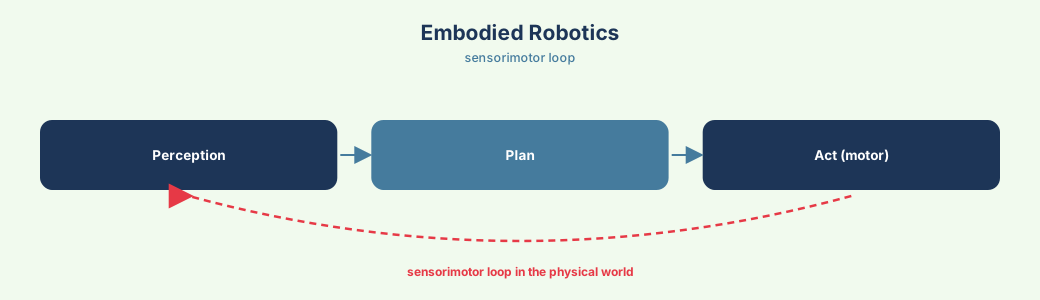
F-IV.34.0— Perception → plan → physical action. Brief: an arm/robot with a camera perceiving objects, a plan in language ("pick up the cup"), and the control policy moving the joints; sensorimotor loop.
1. Definition and short history
Unites perception (CNN/ViT, ch. 03-04), control policy (RL, ch. 26-28) and, recently, LLM planning. Lineage: classical control → deep RL for robotics (2016+) → Vision-Language-Action (VLA) models (2023+).
2. Foundations
- Control theory / cybernetics — sensorimotor loop, stability.
- Physics / mechanics — dynamics, kinematics, contact.
- Probability / stochastic processes — sensory uncertainty, MDPs.
- Geometry — 3D space, transforms, pose.
3. Algorithms and architectures
- Perception — CNN/ViT, sensor fusion (camera, LiDAR, touch).
- Policy — RL (PPO/SAC), imitation learning, behavior cloning.
- Planning — LLM/symbols decompose tasks; world models.
- VLA — single vision+language→action model.
- Sim-to-real — training in simulation + transfer to the real world.
4. Inputs
- Hardware: robot + sensors; GPU for training; embedded compute for inference.
- Data: demonstrations, teleop, massive simulation; real data expensive.
- Data structures: point clouds, maps, trajectories, states.
- Systems: ROS, simulators (Isaac, MuJoCo), real-time control.
5. Specialized life cycle
| Stage | Specialization |
|---|---|
| 0 Problem | Physical task (manipulation, navigation), safety, environment |
| 1 Data | Demonstrations + simulation; domain randomization |
| 2 EDA | Scenario coverage, sim-to-real gaps |
| 3 Modeling | Perception + policy + planner; VLA? |
| 4 Training | RL/imitation in simulation; fine-tune on the real one |
| 5 Evaluation | Task success rate, robustness, safety |
| 5.5 Acceptance | Physical tests, safety limits, fail-safe |
| 6 Production | Real-time control; human supervision; physical guardrails |
| 7 Monitoring | Success, failures, wear, sensor anomalies |
| 8 Retraining | Field data, new objects/environments |
| 9 Governance | Physical safety, accountability, job displacement |
6. Capabilities, modes, and modalities
Bodily-kinesthetic + spatial + executive: manipulation, locomotion, autonomous navigation, vehicles. The type that integrates the most modalities and acts in the physical world (unlike digital agents, ch. 30).
7. Limits, risks, and ethics
Sim-to-real gap; expensive real data; physical safety (risk to people); robustness to unseen environments; legal accountability; impact on jobs.
8. State of the art and examples
Learned manipulation, autonomous vehicles, humanoid robots, VLA models (RT-2-like); trend: robotics foundation models and greater generalization across tasks and bodies.
Hybrid/Neuro-symbolic Paradigm complete (ch. 30–34). Part IV index:
INDEX.kmd.