Part IV · Ch. 17 — Knowledge Graph + Reasoner
Symbolic · Structured knowledge · Graph + description logic (OWL/RDF). Represents facts as entities and relations and infers new facts by logic. Card:
../02-types-of-ai/01-symbolic.kmd.
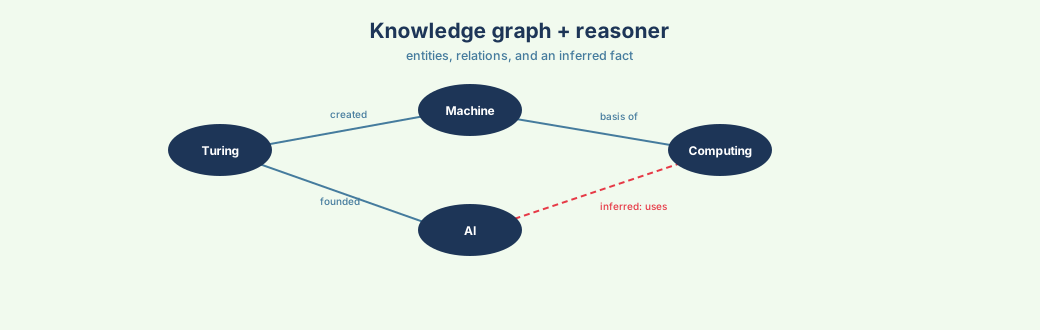
🎨 Figure
F-IV.17.0— Entities and relations. Brief: graph with nodes (people, places, concepts) and labeled edges; a newly inferred edge highlighted (deduction).
1. Definition and short history
Structured knowledge bases with formal semantics. Lineage: Cyc (1984) → semantic web (RDF/OWL) → Google Knowledge Graph and Wikidata.
2. Foundations
- Description logic — OWL, inference of classes/relations.
- Graph theory — structure and traversal.
- Linguistics / ontology — meaning and taxonomies.
- Epistemology — explicit and verifiable knowledge.
3. Algorithms and architectures
- Model — triples
(subject, predicate, object)in RDF. - Reasoner — inference by description logic; rules (SPARQL/Datalog).
- KG embeddings — TransE/etc. for link prediction (bridge with ML).
- Query — SPARQL, graph traversal.
4. Inputs
- Hardware: CPU; large graphs in triple stores.
- Data: curated/extracted facts; ontologies.
- Data structures: triple store, graph indexes, KG embeddings.
- Systems: graph databases (Neo4j), triple stores (Blazegraph).
5. Specialized lifecycle
| Stage | Specialization |
|---|---|
| 0 Problem | Verifiable knowledge, data integration, semantic search |
| 1 Data | Fact extraction/curation; ontology definition |
| 2 EDA | Completeness, consistency, link quality |
| 3 Modeling | Ontology (OWL), inference rules |
| 4 Construction | Populate the graph; entity resolution; (optional) embeddings |
| 5 Evaluation | Fact accuracy, coverage, link prediction |
| 5.5 Acceptance | Logical consistency, source validation |
| 6 Production | Queries/inference; feeds search and RAG (ch. 31) |
| 7 Monitoring | Freshness, broken facts, conflicts |
| 8 Maintenance | Update facts/ontology |
| 9 Governance | Provenance, coverage bias, privacy |
6. Capabilities, modes and modalities
Intellectual/factual: semantic search, data integration, factual QA, GraphRAG; auditable knowledge with provenance.
7. Limits, risks and ethics
Curation cost; incompleteness; coverage bias; hard entity resolution. Combines well with LLMs (factual grounding).
8. State of the art and examples
Wikidata, enterprise Knowledge Graphs, GraphRAG; KG embeddings and LLMs that query graphs to reduce hallucination (links to ch. 31 and 32).