Part V · 1 — The frontier levers
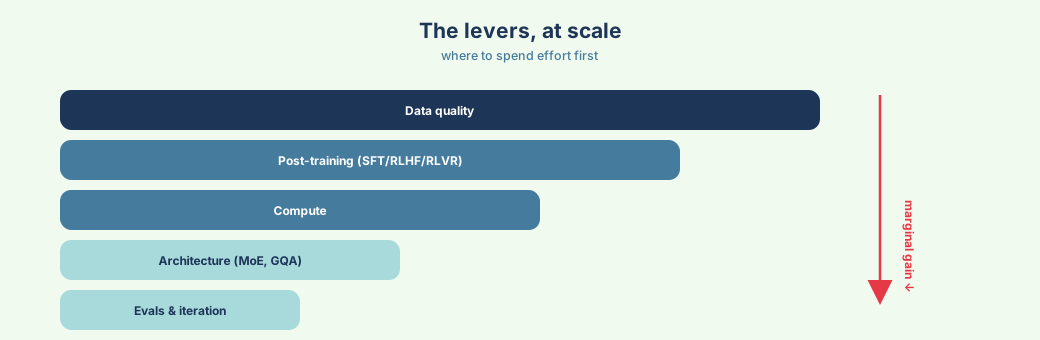
Not every decision matters equally. This is the real order of the levers that move a model's quality — where to spend effort first.
🎨 Figure
F-V.1— The levers, to scale. Brief: infographic of 5 levers (rulers/cranks) of decreasing size: Data (largest) → Post-training → Compute → Architecture → Evals; a "marginal gain" label shrinking. Compendium palette.
1.1 The order of the levers
- Data quality — by far the biggest. FineWeb-Edu vs. raw Common Crawl
= several model classes of difference.
- Post-training (SFT + RLHFDPORLVR) — often yields more than scaling the
model 10×.
- Compute — still matters; in 2024-2026, reasoning RL > pre-training
in marginal gain.
- Architecture — MoE, GQA, efficient attention give 10–30%; not decisive.
- Evals and iteration — without good evaluations, you navigate in the dark.
Common trap: optimizing an exotic architecture before having good data and evals. The frontier models are all Transformers/MoE — the difference is in data and post-training, not in the architecture.
1.2 RLVR — the reasoning paradigm (2024–2026)
The most dramatic gain in reasoning comes from RL with verifiable rewards (RLVR) at massive scale — the foundation of DeepSeek-R1, o1/o3, and Claude's extended thinking.
- Idea: generate an answer with a reasoning chain; verify whether it is right
(test, formal proof, numerical result); reward = pass/fail.
- Algorithms: PPO and GRPO (DeepSeekMath); Process Reward Models (PRMs)
evaluate each step.
- Why it works: domains with cheap verification (code, mathematics)
allow RL at almost-free scale.
1.3 Test-time compute
Spending compute at inference often yields more than scaling the model: multiple samples + verification (best-of-N), MCTS over text, beam search with PRM. It is the foundation of the o1/o3 models and of extended thinking.
1.4 Synthetic data and self-improvement
Every frontier model since 2023 relies heavily on synthetic data:
- Phi (Textbooks Are All You Need), WizardLM (Evol-Instruct), MetaMath.
- Self-Rewarding LMs, ReST^EM (self-training).
- ⚠️ Curse of Recursion: training on generated data without rigorous filtering
degrades the model. Filter by the verifiable ones.
1.5 Long context and memory
Gemini processes 1M–10M tokens; Claude 200K–1M. It changes what "superintelligent" architectures can do.
- Techniques: Positional Interpolation, YaRN, Infini-attention.
- Stabilizing at 128K–2M tokens of effective context in frontier models.
1.6 World models and post-Transformer architectures
- World models (for agents that plan): DreamerV3, Genie 2, V-JEPA.
- Hybrids: Mamba/Mamba-2, Jamba, xLSTM — gains in long-context and efficiency.
- But: the frontier remains Transformer/MoE; the advantage is in data and post-training.
1.7 The scale of the frontier (and why you should not chase it)
Training a frontier model from scratch requires 10,000–100,000 GPUs H100H200B200, 1–6 months of continuous training, checkpointing infrastructure, and billions in capital.
Frontier stack: CUDA, NCCL, Triton, TransformerEngine, cuDNN, DeepSpeed ZeRO/FSDP, Megatron-style pipeline parallelism. Labs spend 15–30% of the technical budget on safety (red teaming, jailbreak defense, interpretability, Constitutional AI, scalable oversight).
Practical conclusion: do not train from scratch. Pick a domain, use an open model, and invest in levers 1–2 (data + post-training). Concrete roadmap in doc 06-ai-for-code.kmd and in the case study 07-kode-case-study.kmd.