Part IV · Ch. 30 — Agent (Agentic AI)
Hybrid · Multimodal + tools · LLM + reasoning/action loop. A model that plans, acts, observes, and iterates toward a goal — not just responds. Card:
../02-types-of-ai/06-hybrid-neuro-symbolic.kmd.
🎨 Figure
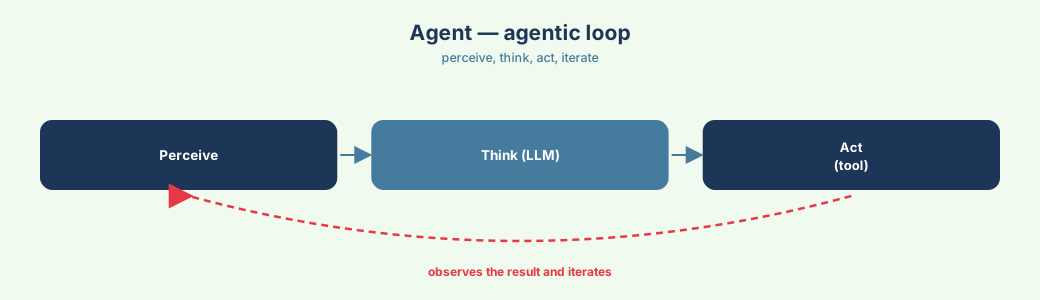
F-IV.30.0— The perceive-think-act loop. Brief: closed cycle: LLM (think) → tool call (act) → result (observe) → back to the LLM; memory alongside; goal at the top.
1. Definition and short history
Couples an LLM (ch. 01) to a control loop with tools, memory, and planning. Lineage: ReAct (2022) → AutoGPT → tool use Reflexion to correct course ([metaphor]: not conscious introspection).
- Multi-agent — several agents cooperating/verifying.
4. Inputs
- Hardware: LLM inference (GPU); orchestration on CPU.
- Data: tool-use traces, environments/sandboxes, task eval.
- Data structures: task graph, vector memory, action history.
- Systems: tool runtime, sandbox, action queue, observability.
5. Specialized life cycle
| Stage | Specialization |
|---|---|
| 0 Problem | Define target tasks, available tools, autonomy limits |
| 1 Data | Traces of successful actions, training/eval environments |
| 2 EDA | Scenario coverage, success rate per task type |
| 3 Modeling | Base LLM + tool schema + planning/memory policy |
| 4 Training | Post-training for tool use; agent RL; fine-tune on traces |
| 5 Evaluation | Task completion rate, steps, cost, safety |
| 5.5 Acceptance | Red team of dangerous actions, sandbox, limits/permissions |
| 6 Production | Loop with real tools; guardrails; human approval for sensitive actions |
| 7 Monitoring | Success, cost per task, risky actions, infinite loops |
| 8 Retraining | New traces, new tools |
| 9 Governance | Autonomy, permissions, action auditing, accountability |
6. Capabilities, modes, and modalities
Intellectual + executive: programming, research, software automation, computer operation, multi-step flows. Combines LLM reasoning with action in the digital world; the basis of assistants that do, not just respond.
7. Limits, risks, and ethics
Compounding errors across many steps; irreversible actions; *prompt injection* via tools/content; cost; the need for authorization and guardrails. Autonomy requires auditing and clear limits.
8. State of the art and examples
Claude Code (engineering agent), computer use agents, multi-agent frameworks; trend: more reliable agents, adversarial verification, persistent memory, and cooperation between agents.