Part IV · Ch. 26 — Deep RL (value)
Reinforcement + connectionist · Games/control · Neural network + value function (Q). Learns which action has the highest expected value in each state, by trial and error. Card:
../02-types-of-ai/05-reinforcement.kmd.
🎨 Figure
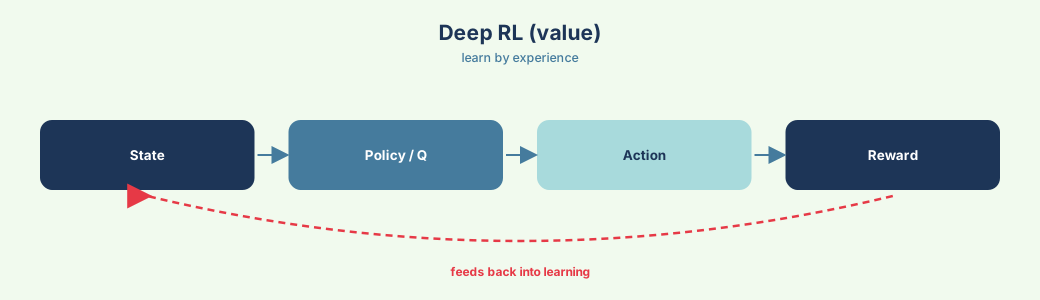
F-IV.26.0— Learning through reward. Brief: agent in an environment (e.g., Atari), receiving state/reward and choosing actions; Q network mapping state→value of each action; replay buffer alongside.
1. Definition and short history
Estimates the action-value function Q(s,a) with a neural network. Milestone: DQN playing Atari directly from pixels (DeepMind, 2013/2015), which kicked off deep RL (see Part III, era 5).
2. Foundations
- Markov decision processes (MDP) — states, actions, reward, transition.
- Dynamic programming — the Bellman equation.
- Probability / stochastic processes — policy, expected return.
- Psychology — operant conditioning (reward).
3. Algorithms and architectures
- Q-learning — Bellman update; off-policy.
- DQN — network approximates Q; experience replay + target network
stabilize it.
- Improvements — Double DQN, Dueling, Prioritized Replay, Rainbow.
- Exploration — ε-greedy, intrinsic motivation.
4. Inputs
- Hardware: GPU; many simulation steps (environment).
- Data: generated by interaction (unlabeled); replay buffer.
- Data structures: replay buffer (ring), state tensors.
- Systems: simulatorsenvironments (GymALE), rollout parallelization.
5. Specialized life cycle
| Stage | Specialization |
|---|---|
| 0 Problem | Environment, discrete action space, reward function |
| 1 Data | Generated by exploration; replay buffer |
| 2 EDA | Reward distribution, reward sparsity |
| 3 Modeling | Q network architecture, improvements (Rainbow), exploration |
| 4 Training | Interaction↔update; unstable; target network |
| 5 Evaluation | Average reward, sample efficiency, stability |
| 5.5 Acceptance | Robustness to unseen states, safety |
| 6 Production | Fixed policy (greedy in Q); lightweight inference |
| 7 Monitoring | Performance, environment distribution shift |
| 8 Retraining | Environment changed → retrain |
| 9 Governance | Safety of the learned behavior |
6. Capabilities, modes, and modalities
Reactive control in discrete actions: games, simple navigation, policy optimization; learns from scratch through experience, without labels.
7. Limits, risks, and ethics
Sample-inefficient (many episodes); unstable; sensitive to reward design (reward hacking); hard in continuous actions (→ ch. 28). Safety during exploration.
8. State of the art and examples
DQN/Rainbow (Atari), R2D2, Agent57; the conceptual basis of modern RL; value combines with policy in actor-critic methods (ch. 28).