Part IV · Ch. 24 — Neuroevolution
*Evolutionary + connectionist · Control/games · Evolution of network topology/weights.* Uses evolution to discover neural network architectures and weights. Card:
../02-types-of-ai/04-evolutionary.kmd.
🎨 Figure
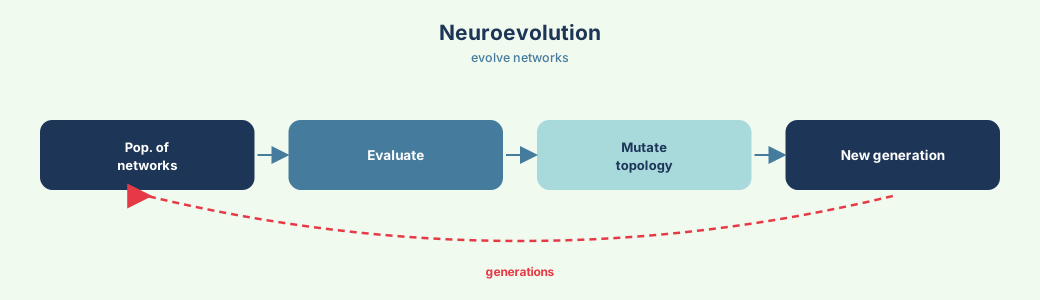
F-IV.24.0— Networks that evolve. Brief: network topologies changing across generations (nodes/connections being added), selected by performance on a control task.
1. Definition and short history
Applies evolutionary algorithms (ch. 23) to neural networks, evolving structure and weights without backprop. Milestones: NEAT (2002), HyperNEAT; resurges in *neural architecture search* and as an alternative to RL.
2. Foundations
- Evolutionary biology — evolution of structures.
- Connectionism — neural networks as phenotype.
- Gradient-free optimization — population search.
- Complex systems theory — gradual complexification.
3. Algorithms and architectures
- NEAT — evolves topology + weights; speciation protects innovation.
- HyperNEAT — generates connectivity patterns (indirect).
- ES for RL — evolution strategies competing with policy gradient.
- Evolutionary NAS — search of deep learning architectures.
4. Inputs
- Hardware: CPU/GPU; highly parallelizable (independent evaluations).
- Data: environment/task + fitness function.
- Data structures: network genomes (graphs), population.
- Systems: NEAT frameworks, parallel-evaluation infrastructure.
5. Specialized lifecycle
| Stage | Specialization |
|---|---|
| 0 Problem | Control/game where the gradient is hard; architecture search |
| 1 Data | Environment + fitness (task reward) |
| 2 EDA | Task difficulty, fitness landscape |
| 3 Modeling | Network encoding, operators, speciation |
| 4 "Training" | Evolve populations of networks |
| 5 Evaluation | Task performance, network complexity |
| 5.5 Acceptance | Robustness, generalization |
| 6 Production | Deploy the best evolved network |
| 7 Monitoring | Performance under novel conditions |
| 8 Retraining | Re-evolve |
| 9 Governance | As per application |
6. Capabilities, modes and modalities
Control/discovery: game agents, robotic control, architecture discovery; learns without backprop — useful with sparse/non- differentiable rewards.
7. Limits, risks and ethics
Cost (many evaluations); limited scale vs gradient-based deep learning; best on small/medium networks. Complements, does not replace, the gradient.
8. State of the art and examples
NEAT and descendants, evolution strategies for RL (OpenAI ES), evolutionary NAS; the niche where the gradient fails or the architecture itself is the search target.