Part IV · Ch. 01 — LLM (Large Language Model)
Connectionist · Language/conversation · Transformer (decoder). The kind of AI that defined the current era: a network that learns to predict the next token and, at sufficient scale, exhibits language, reasoning, code and the ability to use tools. Origin card:
../02-types-of-ai/02-connectionist.kmd.
🎨 Figure
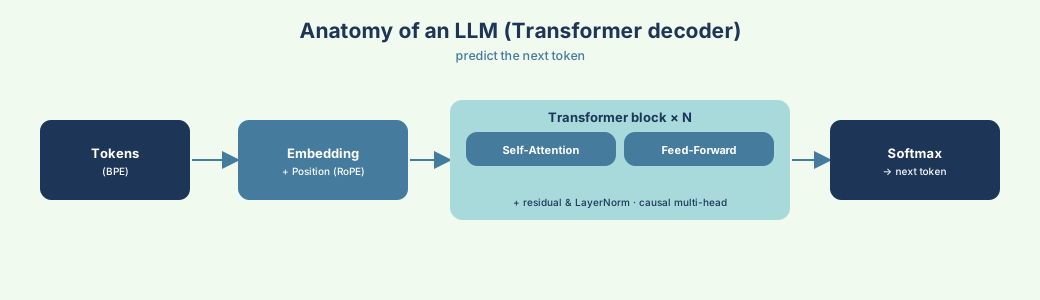
F-IV.1.0— Anatomy of an LLM. Brief: stylized cross-section of a Transformer: tokens coming in → embeddings + position → stack of blocks (multi-head attention + FFN, with residual connections) → projection → distribution over the vocabulary. Attention arrows linking tokens. Compendium palette.
1. Definition and short history
An LLM is a neural network — almost always a Transformer decoder — trained on huge text corpora with a simple objective: given a prefix, predict the next token. From this self-supervised task, at scale, capabilities that were never explicitly programmed emerge: grammar, facts, translation, step-by-step reasoning, programming and dialogue.
Lineage (detail in Part III): n-gram models → word embeddings (word2vec, 2013) → seq2seq + attention (2014) → Transformer (2017) → GPT and the pre-training + scale paradigm (2018–2020) → instruction tuning and RLHF (2022) → multimodal, reasoning and agentic models (2023–present).
2. Foundations (sciences and mathematics)
| Discipline | Role in the LLM | |
|---|---|---|
| Linguistics | Distributional semantics ("the meaning of a word lies in the company it keeps"); morphology (tokenization); emergent syntax/pragmatics | |
| Linear algebra | Everything is a tensor; attention is the matrix product softmax(QKᵀ/√d)·V; embeddings are vectors |
|
| Probability | The output is a distribution `p(token | context)`; sampling controls generation |
| Information theory | Cross-entropy/perplexity as loss and metric; compression as a proxy for learning | |
| Calculus / optimization | Backprop + AdamW tune billions of parameters | |
| Learning theory | Scaling laws: loss decreases predictably with parameters × data × compute | |
| Neuroscience | Loose inspiration (neuron, attention) — [metaphor] for "understanding" |
Anchor formula — attention: Attention(Q,K,V) = softmax( Q·Kᵀ / √dₖ ) · V Each token "looks" at the others with learned weights — the central mechanism.
3. Algorithms and architectures
Transformer block (decoder), repeated N times:
- Tokenization — text → tokens (subwords) via BPE/SentencePiece.
- Embedding + position — vector per token + positional encoding (today
RoPE is common).
- Causal multi-head self-attention — each position attends to the previous
ones (causal mask); several "heads" capture distinct relations.
- Feed-forward (FFN/MLP) — per-position transformation (where much of the
"knowledge" lives).
- Residual connections + LayerNorm — stabilize the training of deep networks.
- Final projection + softmax — distribution over the vocabulary.
Architecture variants and optimizations:
- Mixture-of-Experts (MoE) — sparse routing: more parameters, nearly
constant cost per token.
- GQA/MQA — share keys/values to make inference cheaper.
- FlashAttention — memory-efficient attention (the bottleneck is bandwidth, not FLOPs).
- Long context — RoPE extensions, sparse/windowed attention, hybrid SSM.
Training algorithms:
- Pre-training — self-supervised next-token objective at web scale.
- Post-training — SFT (instructions) → alignment via RLHF / DPO / RLAIF
(see ch. 29 — RLHF); distillation into smaller models.
Inference algorithms:
- Decoding — sampling (temperature, top-k, top-p), beam search.
- Efficiency — KV-cache, speculative decoding, quantization
(int8/int4), continuous batching, paged attention.
4. Inputs
- Hardware: clusters of GPU/TPU (Tensor Cores), HBM memory (the real
bottleneck), interconnect (NVLink/InfiniBand, all-reduce); storage for checkpoints; power/cooling. Inference also uses NPUs and edge.
- Data: web-scale corpora (text, code), deduplicated, quality-filtered,
with a curated mixture (data mixture) and control of benchmark contamination.
- Data structures: tensors; tokenizer/vocabulary (BPE);
embedding tables; KV-cache (inference); vector index (HNSW) for RAG.
- Systems / MLOps: PyTorchJAX + compilers (XLATriton); datatensorpipeline
parallelism + FSDP/ZeRO; orchestration (RaySlurmK8s); serving (vLLM/TGI); model registry and versioning.
5. Specialized life cycle (the 11 stages)
The skeleton of Part I, filled in for LLMs.
| Stage | How it specializes in an LLM |
|---|---|
| 0 · Problem | Define target capabilities (chat, code, reasoning), languages, context window, and the success metrics/benchmarks |
| 1 · Data | Web crawl + code + curation; deduplication, quality/toxicity filtering, data mixture, tokenization; control of evaluation contamination |
| 2 · EDA | Corpus statistics (token, language, domain distribution), leakage and duplicate checks |
| 3 · Modeling | Choose size (scaling laws), depth, number of heads, context, MoE?, tokenizer; compute budget |
| 4 · Training | Pre-training next-token (massive parallelism, checkpointing, mixed precision) → post-training (SFT → RLHF/DPO) |
| 5 · Evaluation | Benchmarks (knowledge, reasoning, code), human evaluation, calibration; contamination caveats |
| 5.5 · Acceptance | Red teamingjailbreak, safety evaluations, system tests (APIcontract), shadow/canary |
| 6 · Production | Serving with KV-cache, batching, quantization, speculative decoding; context management; RAG/tools |
| 7 · Monitoring | Quality drift, refusal rate, latency/cost per token, abuse; correlation by trace_id |
| 8 · Retraining | New data, refreshcontinual, new RLHF iteration; versioning and AB of the new version |
| 9 · Governance | Model card, usage policy, alignment, evaluation transparency, privacy of training data |
🎨 Figure
F-IV.1.1— The life cycle of an LLM. Brief: reuse the ring fromF-I.1, but with stage-specific icons (web data funnel, scaling-laws scale, red-team shield, KV-cache in production). Shows the specialization of the generic cycle.

6. Capabilities, modes and modalities
- Linguistic — generation, translation, summarization, rewriting, dialogue.
- Logical-mathematical — step-by-step reasoning (chain-of-thought),
mathematics, code (related chapter: agents).
- Intellectual and creative mode — from technical writing to fiction
(controlled by sampling/conditioning).
- Agentic — tool use, function calling, computer use
(see ch. 30 — Agent).
- Multimodal — LLMs become the base of models that also see/hear
(see ch. 14 — Multimodal).
Types of intelligence (Gardner's grid, see ../01-life-cycle/04-nature-of-inputs.kmd): strong in linguistic and logical-mathematical; partial in interpersonal (dialogue); absent in bodily-kinesthetic (no body).
7. Limits, risks and ethics
- Hallucination — generates plausible and false statements; mitigable (not
eliminable) with RAG and grounding.
- Bias — inherits biases from the corpus; requires evaluation and mitigation.
- Opacity — billions of poorly interpretable parameters (interpretability
is an open area).
- Cost and energy — training and inference are intensive; environmental
footprint.
- Safety — jailbreaks, misuse; hence alignment (RLHF/RLAIF,
Constitutional AI) and red teaming.
- Data and law — provenance, copyright, corpus privacy.
[metaphor]— an LLM *oes not "understand", does not "want" and is notconscious* It models the statistical distribution of language; "reasoning" is the generation of steps, not formal deduction (see doc 4 of Part I).
8. State of the art and real examples
- Frontier models (2025–2026): the Claude 4.X family (e.g. Opus 4.8,
claude-opus-4-8) and Fable 5 (Anthropic); GPT (OpenAI); Gemini (Google); open weights such as Llama and Mistral. - Trends:
- Reasoning models — long deliberation before answering.
- Long context — windows of hundreds of thousands to millions of tokens.
- MoE — parameter scale with controlled cost.
- Agency — LLMs as the engine of agents that use tools and operate
software (e.g. Claude Code).
- Native multimodality — a single model for text, image, audio and video.
Cross-reference: for API details, model IDs, parameters and caching when building on top of Claude LLMs, use the
claude-apiskill — this chapter is conceptual, not an integration guide.
Template fixed. The next chapters (Diffusion, CNN, RL, Agents…) follow these 8 sections. Index: INDEX.kmd.