Part I · 4 — The nature of inputs: real × formal × metaphor
The conceptually most important chapter of Part I. Many terms we associate with intelligence — reasoning, reflection, intuition, consciousness, shrewdness — circulate in the discourse about AI. But they are not all of the same nature. Conflating them generates both hype and unfounded fear.
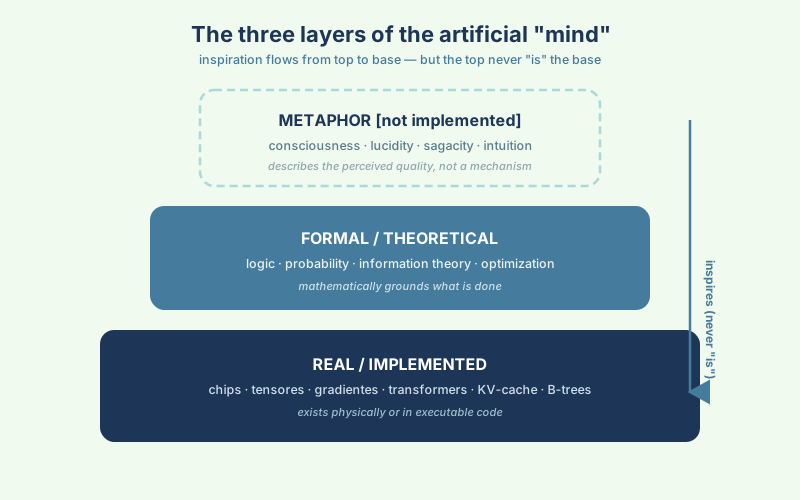
4.1 The three natures
| Nature | Definition | How to treat it in the Compendium |
|---|---|---|
| Real / implemented | Exists physically or in executable code | Describe the mechanism |
| Formal / theoretical | Mathematically grounds what is done | Describe the theory |
Inspirational / metaphor [metaphor] |
Borrowed from the human mind; not literally implemented | Mark [metaphor] and explain what actually exists in its place |
🎨 Figure
F-I.5— The three layers of the artificial "mind". Brief: diagram in three stacked horizontal bands. Base (solid,#1d3557): "Real" — chips, tensors, gradients. Middle (#457b9d): "Formal" — equations, graphs, distributions. Top (translucent, dashed outline,#a8dadc): "Metaphor" — silhouettes of concepts like consciousness/intuition, drawn as semi-transparent ghosts to indicate that they are not mechanisms. Side arrow: "inspires" (from top to base), never "is".
4.2 Cognitive concepts that actually became mechanism or theory
These are real — implemented or formally used:
| Concept | What it really is in AI |
|---|---|
| Logic | Symbolic AI, constraint solvers, formal verification, fuzzy logic. (LLMs do approximate reasoning, not formal deduction.) |
| Inference | Two real senses: (a) statistical inference (estimating distributions/parameters); (b) inference = running the trained model (stage 6). |
| Reasoning | Chain-of-thought, tree/graph-of-thought, "reasoning" models, scratchpads. Reasoning emulated via step generation — useful and real as a technique, not a logical proof. |
| Heuristics | Omnipresent: heuristic sampling, early stopping, pruning, greedy search, hyperparameter choice. |
| Hypothesis / thesis | "Hypothesis space" = functions the model can represent; statistical hypothesis testing (evaluation, A/B). |
| World model | *World models* — networks that learn the dynamics of an environment (RL, robotics, video); internal latent representations. |
| Reflection / metacognition | Self-critique / Reflexion / self-consistency — the model revises its own output. Real as a prompting/training technique; not conscious introspection. |
| Learning | Supervised, unsupervised, self-supervised (the basis of LLMs), reinforcement, in-context learning, meta-learning, transfer/curriculum. |
| Attention / focus | The attention mechanism is literal and central — weights that focus on parts of the input. Perhaps the only cognitive term that became an exact mechanism. |
| Memory | Context window (working memory), KV-cache, RAG/external memory, episodic memory in agents. |
| Behavior | Behavior cloning (imitation), RL policy, behavior alignment (RLHF). |
| Emotion / affect | Affective computing — recognizinggenerating emotion in voiceface/text. Real as a task; the model does not feel. |
4.3 Concepts that are still metaphor — not implemented
These describe the perceived quality of the result, not parts of the system:
| Concept | Status |
|---|---|
| Consciousness | [metaphor] — not implemented. There are theories (Global Workspace, Integrated Information Theory) used as research inspiration, but no current system is conscious. |
| Lucidity / wisdom / shrewdness / cleverness | [metaphor] — they describe the quality of the outputs. There is no "shrewdness module". "Cleverness" ≈ capability + generalization. |
| Intuition | [metaphor] — used for the fast inference of "System 1" (Kahneman) vs. deliberate "System 2" reasoning. A conceptual framework, not a component. |
| Sustained focus | Partial — "attention" is a mechanism; keeping focus on long tasks is context/agent engineering, not a trait. |
| Conscious reflection | [metaphor] — not to be confused with self-critique (a real technique). |
| Theory of mind | Emergent and debated — it is measured whether LLMs model others' beliefs; not a guaranteed faculty. |
| Creativity | [metaphor] operationalized — emerges from sampling with temperature/diversity over the learned distribution. Useful, but not "imagination". |
Principle: when someone says that an AI "understands", "thinks", "wants", or "has consciousness", translate it to the real mechanism. There is almost always one — and it is more modest and more interesting than the metaphor.
4.4 Why the distinction matters for the Compendium
- Technical honesty. An encyclopedic atlas cannot sell metaphor as
mechanism. Each chapter of Part IV describes what actually runs.
- Research map. The frontier between column 4.2 and 4.3 is exactly where
research advances — concepts migrate from "metaphor" to "mechanism" over time (attention made that crossing; reasoning is in the middle of it).
- Realistic capability assessment. It lets us answer "is this AI
intelligent?" without falling into hype or automatic skepticism: it has real, measurable capabilities in certain modalities, and does not have the metaphorical faculties the vocabulary suggests.
4.5 Types and modes of intelligence (referential)
The Compendium uses the multiple intelligences (Gardner) as a map of capabilities — not as a definitive psychological theory, but as a useful grid to show what AI covers and what it still lacks:
| Type of intelligence | How AI addresses it | Maturity |
|---|---|---|
| Linguistic | LLMs, translation, writing | high |
| Logical-mathematical | reasoning models, assisted proof, code | medium-high |
| Spatial / visual | computer vision, image generation, 3D | high |
| Musical | music and audio generation/analysis | medium |
| Bodily-kinesthetic | robotics, motor control, RL | medium-low |
| Interpersonal | dialogue, emotion recognition, agents | medium |
| Intrapersonal | limited self-assessment [partial metaphor] |
low |
| Naturalist | classification, sensing, data science | high |
And the modes (artistic, intellectual, technical) are not separate modules: they emerge from the combination training data + conditioning/prompt + objective function. There is no "artistic circuit" — there is a learned distribution sampled in different ways.
4.6 Closing Part I
The life cycle (docs 1–2), crossed with sciences, mathematics, and inputs (doc 3) and filtered by the real × formal × metaphor distinction (this doc), gives the conceptual skeleton of the whole Compendium. The next parts specialize it:
- Part II — each type of AI in a card.
- Part III — the history that led here.
- Part IV — each type in a chapter, traversing this same life cycle,
now with the concrete details of the category.
Today's artificial intelligence is built from tensors, gradients, data, and architectures. "Cleverness" is the name we give to the quality that emerges from this — not to a part. Holding on to that is holding on to the central thesis of Part I.