Part IV · Ch. 11 — GNN (Graph Neural Network)
Connectionist · Graphs · Message passing. Learns over graph-structured data (molecules, networks, maps). Card:
../02-types-of-ai/02-connectionist.kmd.
🎨 Figure
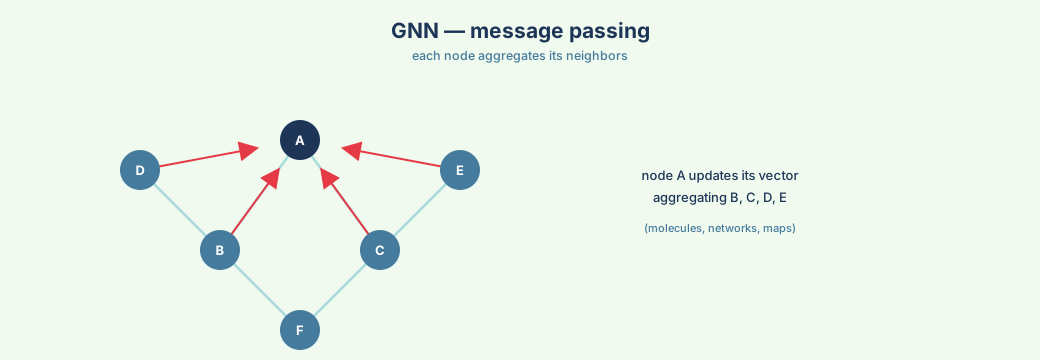
F-IV.11.0— Messages between neighbors. Brief: a graph with nodes exchanging messages (arrows) and updating their vectors; illustrate a molecule as an example.
1. Definition and short history
Generalizes neural networks to graphs, aggregating information from neighbors. A prominent application: a component of AlphaFold and drug discovery.
2. Foundations
- Graph theory — structure, neighborhood, spectral (Laplacian).
- Linear algebra — adjacency matrix, spectral convolution.
- Group theory / symmetries — invariance to node permutation.
- Chemistry/biology — molecules and proteins as graphs.
3. Algorithms and architectures
- Message passing — each node aggregates messages from neighbors and updates state.
- Variants — GCN (convolution), GAT (attention), GraphSAGE (sampling),
MPNN.
- Readout — aggregation for nodeedgegraph prediction.
4. Inputs
- Hardware: GPU; large graphs require sampling/partitioning.
- Data: labeled graphs (molecules, social networks, knowledge graphs).
- Data structures: adjacency lists, sparse tensors.
- Systems: PyG, DGL; neighborhood sampling for scale.
5. Specialized life cycle
| Stage | Specialization |
|---|---|
| 0 Problem | Nodeedgegraph prediction (molecular property, recommendation) |
| 1 Data | Build the graph (nodes, edges, features); labels |
| 2 EDA | Degree, components, homophily, class imbalance |
| 3 Modeling | GCNGATSAGE; depth (risk of over-smoothing) |
| 4 Training | Mini-batch via neighborhood sampling |
| 5 Evaluation | Nodeedge accuracyAUC; inductive generalization |
| 5.5 Acceptance | Robustness to graph perturbation, generalization to new graphs |
| 6 Production | Inference on dynamic graph; incremental update |
| 7 Monitoring | Drift in graph structure |
| 8 Retraining | New nodes/edges |
| 9 Governance | Privacy in social networks, relational bias |
6. Capabilities, modes and modalities
Relational/structural: molecular property, recommendation, fraud detection, traffic/routing, knowledge graph reasoning.
7. Limits, risks and ethics
Over-smoothing with depth; scale on massive graphs; privacy in relational data; homophily bias.
8. State of the art and examples
AlphaFold (a component), GNNs for drug and material discovery, maps (ETA), industrial recommendation; convergence with Transformers (*graph transformers*).