AI Compendium · Part V — Building AI in Practice
From theory to the workshop. Parts I–IV explain what AI is; this part explains how a frontier AI is built today — the real levers, the data, the concrete hardware, the tools, the evaluation, and one exemplary domain (programming). It is the translation of conceptual knowledge into engineering decisions.
🎨 Figure
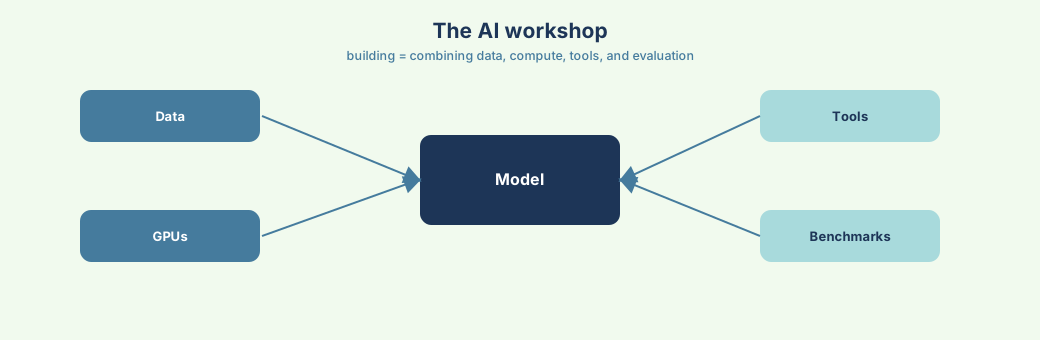
F-V.0— The AI workshop. Brief: isometric aerial view of a stylized "workshop": a data bench (a funnel filtering), a GPU rack, a tools/frameworks panel, a benchmarks gauge, and a conveyor connecting everything to a model at the center. Compendium palette.
The guiding question: what level of ambition?
Before building, situate yourself. The effort and the cost change by orders of magnitude:
| Level | What it is | Who reaches it |
|---|---|---|
| 1 | Using APIs + prompt engineering | Today, anyone |
| 2 | Fine-tuning on a specific domain | A small team |
| 3 | Training from scratch on a specific domain | Startup (\(200k–\)10M) |
| 4 | General frontier | Billion-dollar labs |
Central thesis of this part: for almost everyone, the winning path is open models + fine-tuning + specific domain. Beating the frontier in your domain is worth infinitely more than being mediocre at everything. The billion-dollar labs handle the foundation; you master a niche.
Map of the part
| Doc | Theme |
|---|---|
01-frontier-levers.kmd |
What actually moves the needle: data, post-training, RLVR, test-time compute, scale |
02-data-and-datasets.kmd |
The biggest lever: data quality, datasets, synthetics, filtering |
03-hardware.kmd |
GPUs, VRAM, builds with prices, Blackwell/Rubin, cloud vs on-prem |
04-tools-and-frameworks.kmd |
The practical stack: training, inference, sandbox, eval, observability |
05-benchmarks-and-leaderboards.kmd |
How to evaluate; benchmarks, leaderboards, and why private ones matter |
06-ai-for-code.kmd |
Programming: the best domain for a small team; the 7 ingredients |
07-kode-case-study.kmd |
Case study: applying all of this to build Kode |
How this part talks to the rest of the Compendium
- Specializes the lifecycle (Part I) with concrete decisions for each stage.
- Grounds the types (Part IV) into "how to train/serve this type".
- Anchors itself in the state of the art (Part III, doc 8) for the current numbers.
Timeless × dated: the principles here (data > architecture, post-training, private benchmarks) endure; the numbers (prices, VRAM, models) are from 2026 and should be reread alongside the snapshot in Part III.