Part IV · Ch. 06 — VAE (Variational Autoencoder)
Connectionist · Generation / representation · Probabilistic encoder-decoder. Learns a continuous latent space from which it samples new data; today it is a central piece of larger pipelines (latent diffusion, multimodal tokens). Card:
../02-types-of-ai/02-connectionist.kmd.
🎨 Figure
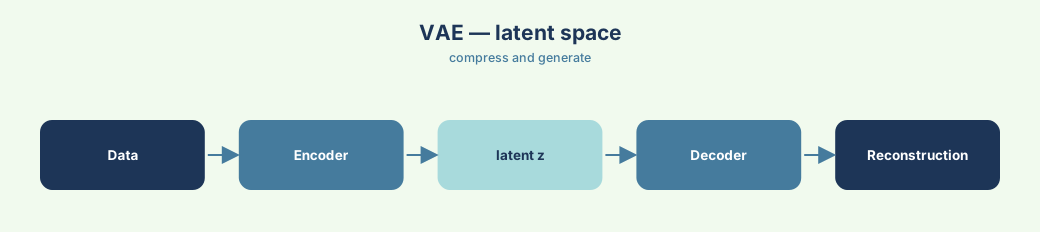
F-IV.6.0— Latent funnel. Brief: an encoder compressing data to a point in a Gaussian latent cloud, and a decoder reconstructing it; sampling a new point generating new data.
1. Definition and short history
An autoencoder that regularizes the latent space to be a continuous distribution (2014). Lineage: VAE → VQ-VAE (discrete latent, the basis of tokens) → component of latent diffusion and of multimodal models.
2. Foundations
- Probability / variational inference — maximizes the ELBO.
- Information theory — the KL term regularizes the latent; compression.
- Measure theory — continuous formulation; reparameterization.
- Linear algebra — encoder/decoder; latent space.
3. Algorithms and architectures
- Encoder — data → latent distribution (μ, σ).
- Reparameterization — sample
z = μ + σ·ε(allows backprop). - Decoder —
z→ reconstruction. - Objective — reconstruction + KL to the prior.
- Variants — VQ-VAE (discrete codebook), β-VAE (disentanglement).
4. Inputs
- Hardware: GPU; lightweight compared to LLM/diffusion.
- Data: the target domain (images, audio).
- Data structures: tensors; codebook (VQ-VAE).
- Systems: PyTorch; used as a frontend for other models.
5. Specialized life cycle
| Stage | Specialization |
|---|---|
| 0 Problem | Compression, generation, or latent tokenizer for another model |
| 1 Data | Target domain; little labeling (self-supervision) |
| 2 EDA | Data structure/variability |
| 3 Modeling | VAE vs VQ-VAE; latent dimension; β |
| 4 Training | Reconstruction + KL; avoid posterior collapse |
| 5 Evaluation | Reconstruction error, sample quality, latent usage |
| 5.5 Acceptance | Validate latent as input to diffusion/multimodal |
| 6 Production | Encoder/decoder in a pipeline (latent diffusion) |
| 7 Monitoring | Reconstruction quality in production |
| 8 Retraining | New domains |
| 9 Governance | Inherited from the system that uses it |
6. Capabilities, modes and modalities
Representation/compression and generation; rarely used alone today — it shines as the latent space of diffusion and as a tokenizer (VQ) for autoregressive multimodal models.
7. Limits, risks and ethics
Samples more "blurred" than GAN/diffusion if used on its own; posterior collapse. Risks inherited from the host pipeline.
8. State of the art and examples
Stable Diffusion's VAE (latent), VQ-VAE/VQGAN, neural audio codecs (EnCodec/Mimi) — ubiquitous as infrastructure, not as an end product.