Part IV · Ch. 02 — Diffusion Model
*Connectionist · Image (and audio/video) generation · U-Net / DiT + diffusion process.* Generates data by learning to reverse a gradual noising process. Card:
../02-types-of-ai/02-connectionist.kmd.
🎨 Figure
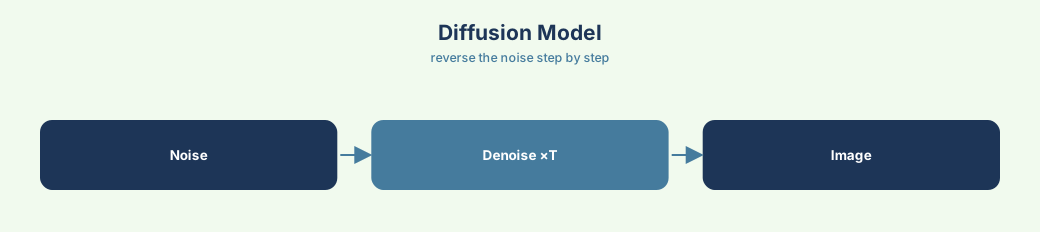
F-IV.2.0— From noise to image. Brief: sequence of frames showing pure noise turning into a sharp image in denoising steps; a "forward" arrow (adds noise) and a "reverse" one (removes). Compendium palette.
1. Definition and short history
A generative model that learns to invert a chain of Gaussian noise addition. Lineage: DDPM (2020) → latent diffusion/Stable Diffusion (2022) → DiT and flow matching (2023+). It replaced GANs as the state of the art in image generation (see Part III, era 6).
2. Foundations
- Physics / statistical mechanics — diffusion and Langevin processes inspire
the method.
- Probability / stochastic processes — Markov chain of noise; SDEs.
- Measure theory — continuous formulation (score-based / SDE).
- Linear algebra and calculus — the score = gradient of the log-density.
- Information theory — ELBO as the variational objective.
3. Algorithms and architectures
- Forward — adds Gaussian noise over T steps until pure noise.
- Reverse — the network predicts the noise (or the score) at each step; denoising.
- Backbone — U-Net (convolutional) or DiT (Transformer over patches).
- Latent diffusion — diffusion in the latent space of a VAE (much cheaper).
- Conditioning — text via cross-attention (CLIP/T5); *classifier-free
guidance*; ControlNet (poses, edges).
- Accelerated sampling — DDIM, solvers (DPM-Solver), distillation (turbo).
4. Inputs
- Hardware: GPU (training and inference); inference lighter than an LLM but
multi-step.
- Data: web-scale image-text pairs (LAION-like), filtered.
- Data structures: image tensors, VAE latents, text embeddings.
- Systems: PyTorch/diffusers; noise schedulers; guidance pipelines.
5. Specialized life cycle
| Stage | Specialization |
|---|---|
| 0 Problem | Define target generation (imageaudiovideo), conditioning (text?), quality |
| 1 Data | Image-text pairs, deduplication, filtering (NSFW, quality, aesthetics) |
| 2 EDA | Distribution of resolutions, captions, dataset biases |
| 3 Modeling | U-Net vs DiT, latent space (VAE), scheduler, conditioning |
| 4 Training | Predict noise/score; checkpointing; long and costly |
| 5 Evaluation | FID, CLIP-score, human evaluation of fidelity and prompt alignment |
| 5.5 Acceptance | Safety filters (content), red team of prompts, watermark |
| 6 Production | Sampling in N steps, guidance, acceleration (DDIM/distillation), queues |
| 7 Monitoring | Quality, latency per step, abuse/forbidden content |
| 8 Retraining | New data/styles, fine-tuning (LoRA, DreamBooth) |
| 9 Governance | Provenance, style copyright, watermark, consent |
6. Capabilities, modes and modalities
Strong in artistic/visual mode: text→image, inpainting, outpainting, super-resolution, editing; extends to audio, music and video. Creativity = conditioned sampling ([metaphor], not "imagination").
7. Limits, risks and ethics
Multi-step cost; deepfakes and disinformation; aesthetic/representation biases; style copyright; harmful content. Mitigations: filters, watermarking (C2PA), data curation.
8. State of the art and examples
Stable Diffusion 3, DALL·E, Midjourney, Imagen, FLUX; trend: flow matching, DiT, video generation (see ch. 10), distillation for real time.