Part IV · Ch. 29 — RLHF / RLAIF
*Reinforcement + connectionist · Language alignment · Reward model + PPO/DPO.* Aligns LLMs (ch. 01) by using human (or AI) feedback as reward. Card:
../02-types-of-ai/05-reinforcement.kmd.
🎨 Figure
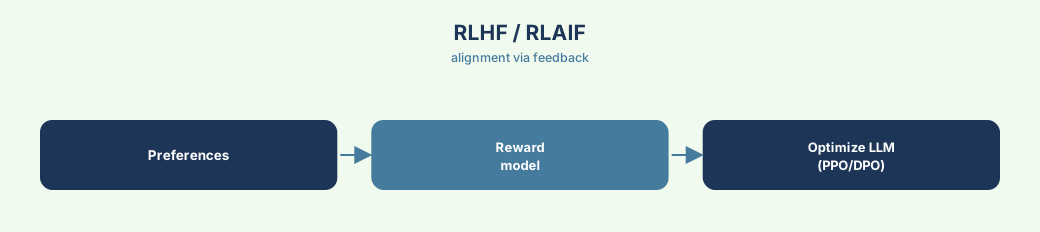
F-IV.29.0— From feedback to behavior. Brief: humans comparing two responses → reward model learns the preference → LLM is optimized to maximize it; arrows of the RL loop.
1. Definition and short history
Turns human preferences into a reward signal to adjust the behavior of an LLM. Milestone: InstructGPT (2022) and ChatGPT; Constitutional AI / RLAIF (Anthropic) uses principles and AI feedback. It is what turns a raw LLM into a helpful, honest, and safe assistant.
2. Foundations
- Decision/utility theory — preferences → reward function.
- Optimization / RL — PPO; or DPO (direct optimization, without explicit RL).
- Psychometrics — quality and consistency of the human label.
- Ethics / philosophy — which values to align to, and whose.
3. Algorithms and architectures
- Preference collection — humans (or AI) compare responses.
- Reward model — learns to predict the preference.
- Optimization — PPO maximizes reward with a KL penalty to the base model
(avoids over-optimization).
- DPO — derives the policy directly from preferences (simpler/more stable).
- RLAIF / Constitutional AI — AI-generated feedback guided by principles.
4. Inputs
- Hardware: GPU (training the reward model + optimizing the LLM).
- Data: preference pairs (human/AI); diverse prompts.
- Data structures: comparison datasets, reward scores.
- Systems: annotation infra, RL/DPO pipeline, alignment eval.
5. Specialized life cycle
| Stage | Specialization |
|---|---|
| 0 Problem | Define target behavior (helpfulhonestharmless) and principles |
| 1 Data | Collect preferences (human labelers or AI); guidelines |
| 2 EDA | Inter-annotator agreement, topic coverage, bias |
| 3 Modeling | Reward model; choose PPO vs DPO; constitution (RLAIF) |
| 4 Training | Train reward → optimize LLM (with KL to base) |
| 5 Evaluation | Human win rate, safety, appropriate refusal, reward hacking |
| 5.5 Acceptance | Red team, jailbreak, bias, refusal calibration |
| 6 Production | Aligned model served (it's phase 4/post-training of the LLM) |
| 7 Monitoring | Refusal rate, complaints, behavior drift |
| 8 Retraining | New preferences/policies; new iteration |
| 9 Governance | Which values, whose; transparency; sycophancy; safety |
6. Capabilities, modes, and modalities
Not an autonomous "type", but rather the alignment stage that shapes the behavior of LLMs and multimodal models (ch. 01, 14). It defines helpfulness, tone, safety, and refusal.
7. Limits, risks, and ethics
Reward hacking and over-optimization; sycophancy (flattery); bias from labelers; "align to which values?" is an open question; annotation cost. RLAIF reduces cost but inherits biases from the judge model.
8. State of the art and examples
InstructGPTChatGPT (RLHF), Claude (Constitutional AIRLAIF), DPO and variants (simplify the pipeline); a central area of AI safety and alignment, in rapid evolution.
Reinforcement Paradigm complete (ch. 26–29). Part IV index:
INDEX.kmd.