Part IV · Ch. 15 — Expert System
Symbolic · Knowledge/diagnosis · Rule base + inference engine. Captures a human expert's knowledge in explicit rules and infers conclusions. Card:
../02-types-of-ai/01-symbolic.kmd.
🎨 Figure
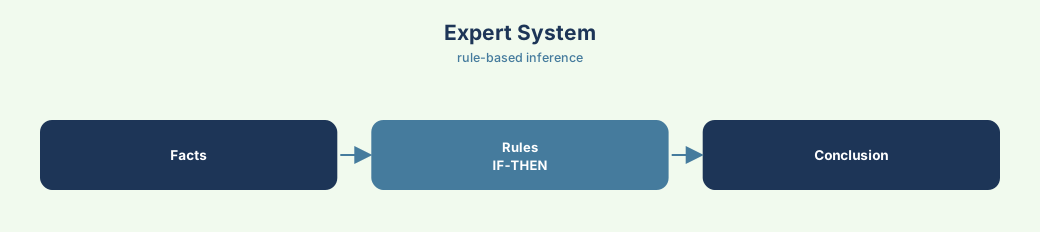
F-IV.15.0— Rules that diagnose. Brief: an IF-THEN rule base feeding an inference engine that chains facts to a conclusion, with an explanation of the path.
1. Definition and short history
A program that reasons via production rules in a narrow domain. Its heyday in the 1970s-80s (MYCIN, DENDRAL, XCON) — see Part III, era 3.
2. Foundations
- Logic — rules, chaining, modus ponens.
- Knowledge engineering — extracting and formalizing expertise.
- Philosophy / epistemology — knowledge representation.
3. Algorithms and architectures
- Rule base + fact base + inference engine.
- Chaining — forward (data→conclusion) and backward (goal→evidence).
- Rete — efficient rule matching.
- Explanation — traces the inference path (transparency).
4. Inputs
- Hardware: CPU; lightweight.
- Data: knowledge elicited from experts (not training data).
- Data structures: rules, working memory, Rete network.
- Systems: expert-system shells (CLIPS, Drools).
5. Specialized lifecycle
| Stage | Specialization |
|---|---|
| 0 Problem | Narrow, well-defined domain with clear expertise |
| 1 Data | Knowledge elicitation (interviews), not data collection |
| 2 EDA | Validate consistency/completeness of the rules |
| 3 Modeling | Structure the rule base + inference strategy |
| 4 "Training" | No statistical training — there is rule coding |
| 5 Evaluation | Accuracy vs experts; case coverage |
| 5.5 Homologation | Test cases, rule conflicts, expert validation |
| 6 Production | The engine runs over new facts; explanation to the user |
| 7 Monitoring | Uncovered cases, conflicting rules |
| 8 Maintenance | Update rules (expensive — no re-training) |
| 9 Governance | Accountability of the knowledge, auditability (strong) |
6. Capabilities, modes and modalities
Intellectual/diagnostic: diagnosis, configuration, help desk, compliance; fully explainable and auditable.
7. Limits, risks and ethics
Brittleness (fragile outside its scope); maintenance cost; does not learn on its own; knowledge acquisition bottleneck. Its strength: total transparency.
8. State of the art and examples
Business-rule engines (Drools), compliance and configuration systems; a revival in neuro-symbolic hybrids (ch. 32), where they provide the verifiable layer.