Part IV · Ch. 22 — Classical ML (Trees, Boosting, SVM)
Probabilistic/statistical · Tabular data · Trees / margins / kernels. Statistical models that still beat deep learning on tabular data. Card:
../02-types-of-ai/03-probabilistic.kmd.
🎨 Figure
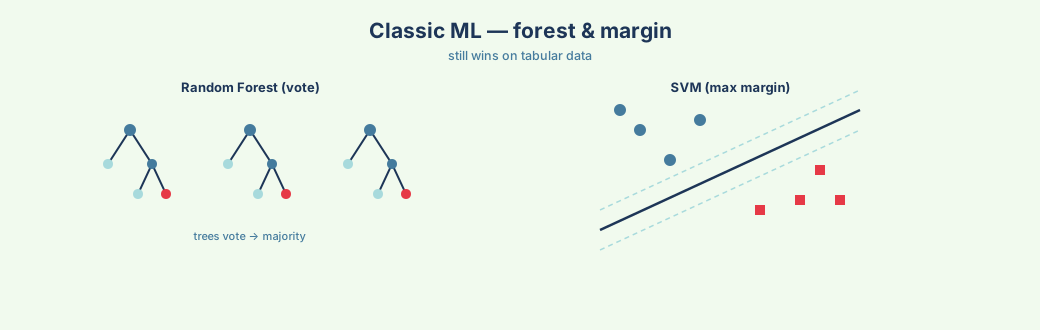
F-IV.22.0— Forest of decisions. Brief: several decision trees voting (ensemble) on the left; on the right, a maximum-margin hyperplane (SVM) separating classes.
1. Definition and short history
Pre-deep-learning statistical family, still dominant on tabular data. Lineage: SVM (1995), Random Forests (2001), Gradient Boosting (XGBoost, 2014+) — Kaggle champions and production staples in finance.
2. Foundations
- Statistics / learning theory — bias-variance, generalization (VC).
- Optimization — boosting (functional descent), maximum margin.
- Probability — bagging, error estimation.
- Linear algebra — kernels (SVM).
3. Algorithms and architectures
- Decision trees — partitions by features.
- Random Forest — bagging of trees (reduces variance).
- Gradient Boosting — sequential trees that correct the error (XGBoost,
LightGBM, CatBoost).
- SVM — maximum-margin hyperplane + kernel trick.
4. Inputs
- Hardware: CPU (efficient); optional GPU for large boosting.
- Data: tabular with engineered features; moderate volumes.
- Data structures: tables, trees, feature matrices.
- Systems: scikit-learn, XGBoost/LightGBM.
5. Specialized lifecycle
| Stage | Specialization |
|---|---|
| 0 Problem | Prediction on tabular data, interpretability, low cost |
| 1 Data | Tables; feature engineering is decisive |
| 2 EDA | Correlations, feature importance, leakage |
| 3 Modeling | TreeRFboosting/SVM; regularization |
| 4 Training | Fast; cross-validation; hyperparameter tuning |
| 5 Evaluation | AUCF1RMSE; feature importance; SHAP |
| 5.5 Acceptance | Stability, fairness, robustness |
| 6 Production | Light, fast inference; easy to serve |
| 7 Monitoring | Feature drift, degradation |
| 8 Retraining | Cheap and frequent retraining |
| 9 Governance | Explainability (SHAP), bias, regulated decisions (credit) |
6. Capabilities, modes and modalities
Predictive/tabular: credit, fraud, churn, pricing, ranking; fast, robust and interpretable — the industry's "workhorse".
7. Limits, risks and ethics
Does not handle unstructured data well (text/image); depends on *feature engineering*; biases in sensitive decisions (credit) require auditing.
8. State of the art and examples
XGBoostLightGBMCatBoost (standard in tabular and Kaggle); still the first choice for tabular data, where it frequently outperforms deep networks.
Complete Probabilistic/Bayesian paradigm (chs. 19–22). Index:
INDEX.kmd.