Part I · 1 — Life cycle overview
The 11 stages, what enters and exits each one, and — most importantly — why the cycle is a loop, not a straight line.
1.1 The 11 stages
The life cycle of an AI, in engineering practice (MLOps), has between 7 and 10 stages depending on how you group them. The Compendium adopts an 11-stage division (numbered 0 to 9, with validation as 5.5), as the most didactic:
| # | Stage | Question it answers |
|---|---|---|
| 0 | Problem definition | What do we want the AI to do, and how do we measure success? |
| 1 | Data collection and engineering | Where does the knowledge come from, and in what form? |
| 2 | Exploratory analysis (EDA) | How do the data actually behave? |
| 3 | Modeling | What shape will the intelligence take? |
| 4 | Training | How does it learn from the data? |
| 5 | Model evaluation | Did it learn well (statistically)? |
| 5.5 | Testing / Validation | Is the whole system ready for the real world? |
| 6 | Production / Deployment | How does it serve answers at scale? |
| 7 | Monitoring | Does it stay good over time? |
| 8 | Maintenance / Retraining | How does it update without forgetting what it knew? |
| 9 | Governance and decommissioning | Is it safe, fair, legal — and when to retire it? |
1.2 Inputs and outputs of each stage
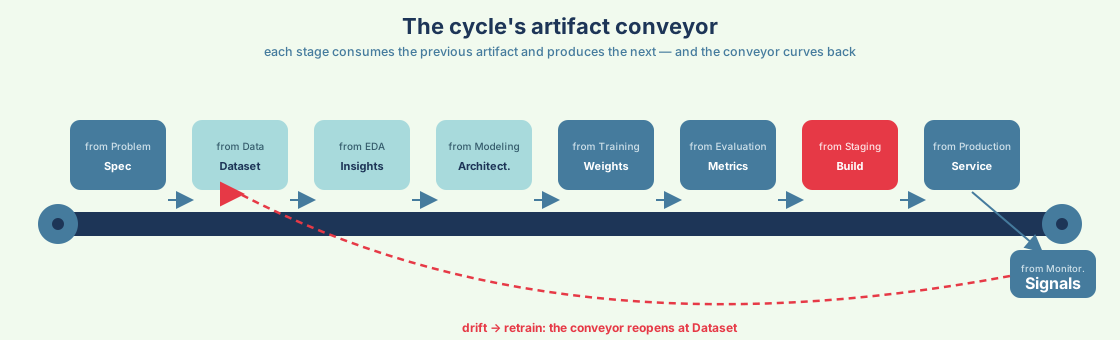
Each stage consumes the output of the previous one and produces an artifact for the next. Thinking in terms of artifacts makes the cycle concrete:
direction: right
need: "Business\nneed"            { style.fill: "#f1faee" }
spec: "Problem spec\n+ metric"    { style.fill: "#f1faee" }
dataset: "Clean dataset\n+ features" { style.fill: "#f1faee" }
insight: "Insights\n(distributions)" { style.fill: "#f1faee" }
arch: "Defined\narchitecture"     { style.fill: "#f1faee" }
weights: "Trained\nweights"       { style.fill: "#f1faee" }
metrics: "Metrics\nreport"        { style.fill: "#f1faee" }
release: "Validated\nbuild"       { style.fill: "#f1faee" }
service: "Service\nin production"  { style.fill: "#f1faee" }
signals: "Health +\ndrift signals" { style.fill: "#f1faee" }

need -> spec: "0"
spec -> dataset: "1"
dataset -> insight: "2"
insight -> arch: "3"
arch -> weights: "4"
weights -> metrics: "5"
metrics -> release: "5.5"
release -> service: "6"
service -> signals: "7"
signals -> dataset: "8 (loop)"
🎨 Figure
F-I.2— Artifact conveyor of the cycle. Brief: horizontal "assembly line" style illustration, each station producing a stylized artifact-object (a blueprint for the spec, a data crystal, a chart for EDA, a network skeleton for architecture, a cube of weights, a report card for metrics, a seal for validation, a server for production, a sensor panel for monitoring), with the conveyor curving back to the start to close the loop.
1.3 The cycle is not linear — it is a loop with enveloping governance
Two structural facts distinguish the life cycle from a simple pipeline:
(a) The feedback loop. Stage 7 (Monitoring) detects drift — a change in the distribution of data or in the behavior of the world — and triggers stage 8 (Retraining), which reopens stages 1 and 4. An AI in production is never "done"; it degrades if the world changes and it does not.
(b) The enveloping governance. Stage 9 (Governance) is not just "the last one". It frames stage 0 (what is ethical/legal to build?) and governs stage 6 (what is safe/fair to serve?). In the index diagram, it is the outer ring.
Didactic consequence: when studying any type of AI in Part IV, the question is not "what stage is it in?", but "how does it traverse the loop, and what changes on each turn?".
1.4 Where "intelligence" lives
It is worth anticipating an idea that all of Part I develops: the "intelligence" of a system does not reside in any isolated stage. It emerges from the combination of:
- a well-framed problem (stage 0),
- rich, representative data (stage 1),
- an architecture with the right inductive bias (stage 3),
- and a well-calibrated learning process (stage 4).
Terms like "cleverness", "lucidity", or "shrewdness" describe the *perceived quality* of the result — they are not ingredients of any stage. That frontier between mechanism and metaphor is the theme of doc 04-nature-of-inputs.kmd.
1.5 Alternative groupings
There are coarser cuts, equally valid — useful for talking to different audiences:
| Cut | Groups |
|---|---|
| 3 phases (the most common in conversation) | Modeling · Training · Production |
| Preparation / Model / Operation | 0–2 · 3–5.5 · 6–9 |
| Offline / Online | 0–5.5 (offline) · 6–9 (online) |
| Data-centric / Model-centric / Ops-centric | 1–2 · 3–5 · 6–9 |
The Compendium uses the 11 stages as the fine-grained reference, but maps to those cuts when it helps to explain.
Next doc: 02-stages-in-detail.kmd opens each stage in depth — inputs, outputs, resources, sciences, and mathematics.