AI Compendium · Part I — The AI Life Cycle
The opening of the Compendium. Before cataloging types of AI, one must understand the process that every AI goes through — from framing the problem to decommissioning. This part is the didactic illustration of that cycle, stage by stage, with the sciences, the mathematics, and the inputs each stage mobilizes.
Why start with the life cycle
Each type of AI (Parts II and IV) is a specialization of this same cycle. An LLM, an image diffusion model, and a robotics agent differ in architecture and data — but all of them go through framing the problem, gathering data, modeling, training, evaluating, validating, deploying, monitoring, and retraining. Understanding the cycle once is understanding the skeleton of every chapter that follows.
The map of this part
| Doc | Content |
|---|---|
01-overview.kmd |
The 11 stages, the cyclic (non-linear) character, and the master cycle diagram |
02-stages-in-detail.kmd |
Each stage in depth: inputs, outputs, resources, sciences, and mathematics |
03-sciences-and-mathematics.kmd |
The master matrices — mathematics × stage, sciences × stage, inputs × stage |
04-nature-of-inputs.kmd |
Real × formal × metaphor: what of cognition has already become engineering, and what is still only inspiration |
The cycle at a glance
direction: right
title: |md
  # The 11 stages of an AI's life cycle
| { near: top-center }

prob: "0 · Problem"          { shape: circle; style.fill: "#1d3557"; style.font-color: "#fff" }
dados: "1 · Data"            { shape: circle; style.fill: "#457b9d"; style.font-color: "#fff" }
eda: "2 · EDA"               { shape: circle; style.fill: "#457b9d"; style.font-color: "#fff" }
model: "3 · Modeling"        { shape: circle; style.fill: "#a8dadc" }
treino: "4 · Training"       { shape: circle; style.fill: "#a8dadc" }
aval: "5 · Evaluation"       { shape: circle; style.fill: "#a8dadc" }
homol: "5.5 · Validation"    { shape: circle; style.fill: "#e63946"; style.font-color: "#fff" }
prod: "6 · Production"       { shape: circle; style.fill: "#457b9d"; style.font-color: "#fff" }
monit: "7 · Monitoring"      { shape: circle; style.fill: "#457b9d"; style.font-color: "#fff" }
retr: "8 · Retraining"       { shape: circle; style.fill: "#457b9d"; style.font-color: "#fff" }
gov: "9 · Governance"        { shape: circle; style.fill: "#1d3557"; style.font-color: "#fff" }

prob -> dados -> eda -> model -> treino -> aval -> homol -> prod -> monit
monit -> retr: drift detected
retr -> dados: new cycle
gov -> prob: frames
gov -> prod: governs
🎨 Figure
F-I.1— The AI life cycle as a didactic ring. Brief: circular illustration (clean infographic style, Compendium palette) with the 11 stages arranged in a ring; flow arrows clockwise; a return arrow highlighted (Monitoring → Retraining → Data) showing the loop; Governance (stage 9) as an outer ring that "embraces" all the others; small icons per stage (magnifier for EDA, gear for Training, shield for Validation, rocket for Production, sensor for Monitoring). Replaces the D2 diagram above in the final version.
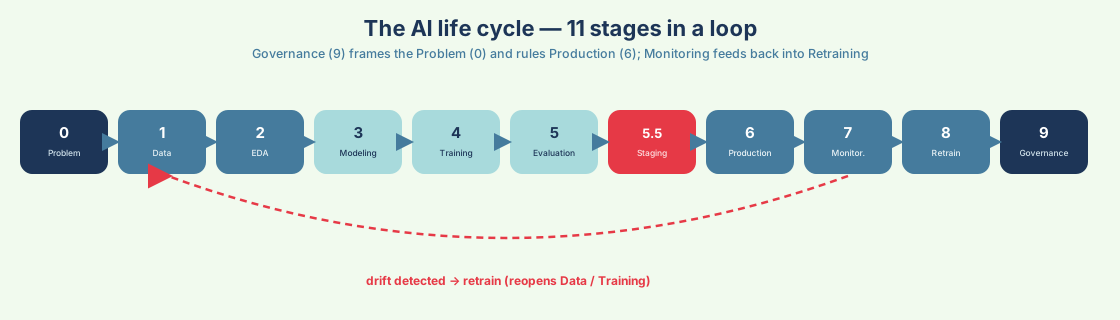
*Initial SVG version (Compendium house style) — the ring
F-I.1will be the final art; this track variant is already embeddable in web and PDF.*
How to read this part
- Stages 0–2 (Problem, Data, EDA) — preparation; dominated by
statistics and framing.
- Stages 3–5 (Modeling, Training, Evaluation) — the core; where
continuous mathematics (linear algebra, calculus, optimization) peaks.
- Stage 5.5 (Validation) — the quality gate of the system, distinct
from the evaluation of the model.
- Stages 6–9 (Production, Monitoring, Retraining, Governance) —
operation; applied statistics, control theory, ethics, and law.
The central point: it is not a line, it is a loop. Monitoring feeds retraining, which reopens the cycle. That is what distinguishes a "life cycle" from a one-way pipeline.