AI Compendium · Part II — Panel of AI Types
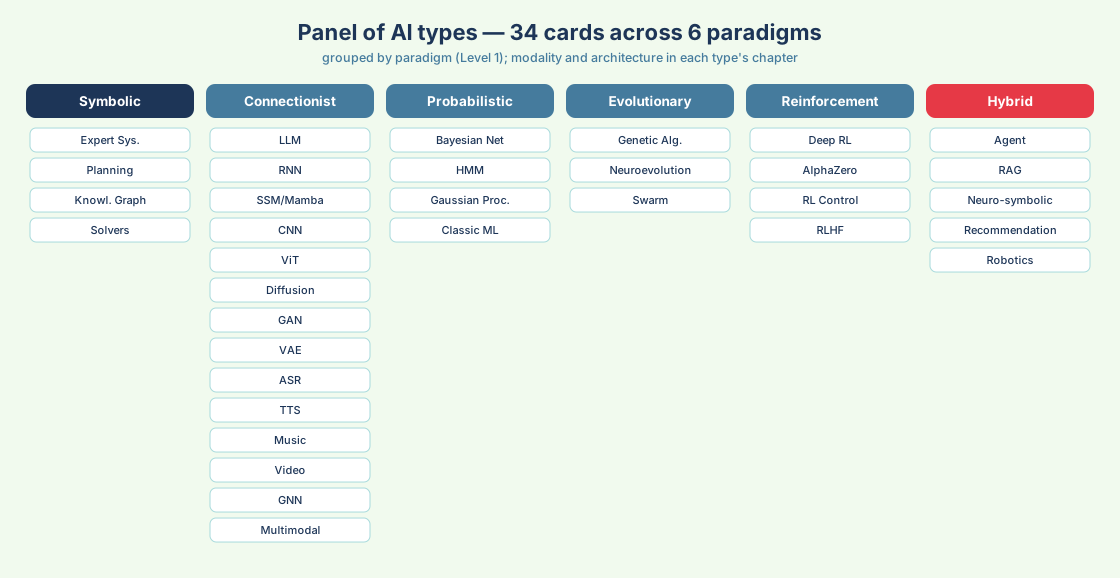
A visual overview: each type of AI presented in a compact card. The panel is the gateway to the encyclopedic chapters of Part IV — each card points to the chapter that details it.
How the panel is organized
The types are addressed by the triad of the hybrid taxonomy defined in the master index: Paradigm → Modality → Architecture. The panel's primary grouping is by paradigm (Level 1) — the "school" of AI. Within each paradigm, the cards carry their modality and architecture.
direction: right
IA: "Types of AI" { style.fill: "#1d3557"; style.font-color: "#fff" }

sim: "Symbolic"            { style.fill: "#457b9d"; style.font-color: "#fff" }
con: "Connectionist\n(Deep Learning)" { style.fill: "#457b9d"; style.font-color: "#fff" }
prob: "Probabilistic\n/ Bayesian" { style.fill: "#457b9d"; style.font-color: "#fff" }
evo: "Evolutionary"            { style.fill: "#457b9d"; style.font-color: "#fff" }
rl: "Reinforcement"           { style.fill: "#457b9d"; style.font-color: "#fff" }
hib: "Hybrid\n/ Neuro-symbolic" { style.fill: "#457b9d"; style.font-color: "#fff" }

IA -> sim
IA -> con
IA -> prob
IA -> evo
IA -> rl
IA -> hib

con -> "LLM": Transformer
con -> "Diffusion": U-Net/DiT
con -> "Vision (CNN/ViT)"
con -> "Audio/Music"
con -> "Video"
con -> "Multimodal"
sim -> "Expert system"
sim -> "Planner/search"
prob -> "Bayesian network"
evo -> "Genetic alg."
rl -> "Deep RL"
hib -> "Agent / RAG"
🎨 Figure
F-II.1— Mural of cards. Brief: a "collection gallery" style mural, 6 columns (one per paradigm), each column with stacked cards; each card with an icon, a name, and a color band for its modality. Sticker-collection / visual-encyclopedia style. Compendium palette; each column header in the color#1d3557.
Anatomy of a card
Every card follows the same template (rendered as a card on web/PDF):
<icon>Type name Paradigm · Modality · Architecture
- What it is: one-sentence definition.
- Examples: recognizable real systems.
- Algorithmic basis: the core algorithm/architecture.
- Peak: period of greatest prominence.
- Capabilities / modes: what it knows how to do.
- → Part IV: link to the chapter (planned).
The six galleries
| Gallery (paradigm) | Content | Cards |
|---|---|---|
01-symbolic.kmd |
Expert systems, planning, logic, knowledge graphs | 4 |
02-connectionist.kmd |
Deep learning: LLMs, diffusion, vision, audio, video, multimodal, GNN, SSM, MoE | 14 |
03-probabilistic.kmd |
Bayesian networks, HMM, Gaussian processes, classical ML | 4 |
04-evolutionary.kmd |
Genetic algorithms, neuroevolution, swarm intelligence | 3 |
05-reinforcement.kmd |
Deep RL, AlphaZero, RLHF, control | 4 |
06-hybrid-neuro-symbolic.kmd |
Agents, RAG, neuro-symbolic, recommendation, embodied robotics | 5 |
The panel does not exhaust the combinations of the taxonomy — it highlights the most recognizable types. Part IV may open chapters for intersections not covered here (every gap in the panel is a candidate for a chapter).