Part IV · Ch. 19 — Bayesian Network
Probabilistic · Causal/diagnostic inference · Directed acyclic graph (DAG). Represents conditional dependencies between variables and infers posterior probabilities. Card:
../02-types-of-ai/03-probabilistic.kmd.
🎨 Figure
F-IV.19.0— Belief that propagates. Brief: DAG of variables (e.g., symptom→disease) with probability tables; observed evidence updating posteriors across the graph.
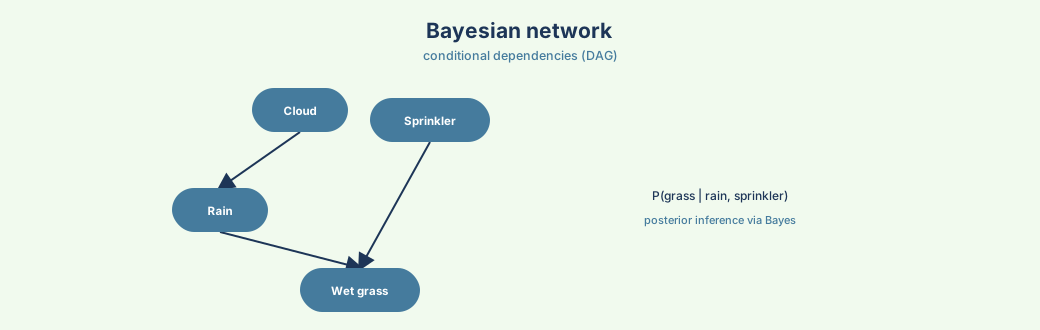
1. Definition and short history
Probabilistic graphical model (Judea Pearl, 1980s-90s; Turing Award 2011) that factors a joint distribution by dependencies. Foundation of causal reasoning.
2. Foundations
- Probability — Bayes' rule, conditional independence.
- Graph theory — DAG, d-separation.
- Causal inference — do-calculus, interventions.
- Statistics — parameter estimation.
3. Algorithms and architectures
- Structure — DAG + conditional probability tables (CPTs).
- Exact inference — variable elimination, junction tree.
- Approximate inference — belief propagation, MCMC, variational.
- Learning — of structure and of parameters (from data).
4. Inputs
- Hardware: CPU; inference can be expensive (NP-hard in general).
- Data: observations to estimate CPTs; domain knowledge for structure.
- Data structures: DAG, CPTs, factor graphs.
- Systems: pgmpy, probabilistic inference libraries.
5. Specialized lifecycle
| Stage | Specialization |
|---|---|
| 0 Problem | Diagnosis/risk with uncertainty and need for causal explanation |
| 1 Data | Observations + structure knowledge |
| 2 EDA | Correlations, independences, missing data |
| 3 Modeling | Define/learn DAG; CPTs |
| 4 Training | Estimate parameters (and structure) from data |
| 5 Evaluation | Calibration, log-likelihood, diagnostic accuracy |
| 5.5 Acceptance | Validate causal structure with experts |
| 6 Production | Posterior inference given evidence; explainable |
| 7 Monitoring | Distribution drift |
| 8 Retraining | Re-estimate with new data |
| 9 Governance | Causal transparency, use in sensitive decisions |
6. Capabilities, modes and modalities
Intellectual/diagnostic: medical diagnosis, risk assessment, causal reasoning, sensor fusion; calibrated and explainable uncertainty.
7. Limits, risks and ethics
Exact inference is expensive; causal structure is hard to learn; does not scale to unstructured data. Strength: causality and interpretability.
8. State of the art and examples
Diagnosis, risk, causal inference (Pearl); convergence with deep learning in deep probabilistic models and causal ML; relevant where cause matters more than correlation.