Part IV · Ch. 23 — Genetic / Evolutionary Algorithm
Evolutionary · Optimizationsearch · Population + selectionmutation/crossover. Evolves a population of solutions guided by a fitness function. Card:
../02-types-of-ai/04-evolutionary.kmd.
🎨 Figure
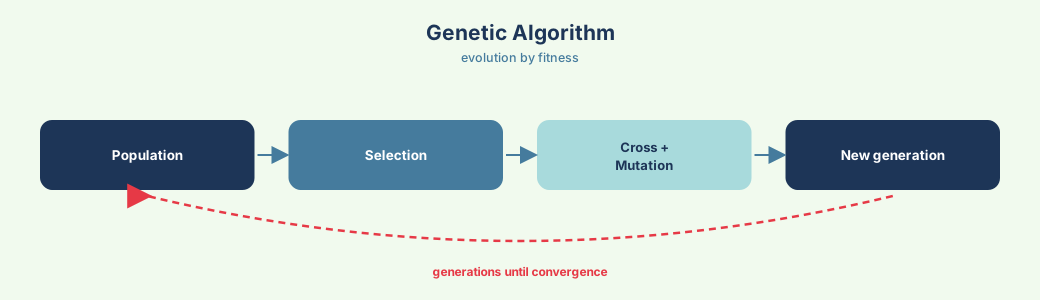
F-IV.23.0— Selection across generations. Brief: a population of solutions (varied shapes) being filtered by fitness, recombined and mutated each generation, converging toward an optimal shape.
1. Definition and short history
Optimization inspired by natural evolution (Holland, 1970s). Solves black-box problems without gradients; used from antenna design (NASA) to neural architecture search.
2. Foundations
- Evolutionary biology — selection, mutation, recombination.
- Optimization — global stochastic search, fitness landscapes.
- Probability — stochastic operators.
- Complex systems theory — emergence through population.
3. Algorithms and architectures
- Representation — encoding solutions (genome).
- Operators — selection (tournament/roulette), crossover, mutation, elitism.
- Evolution strategies — CMA-ES (adapts the search distribution).
- Variants — genetic programming (evolves programs/trees), multi-objective
(NSGA-II).
4. Inputs
- Hardware: CPU (parallelizable per individual); GPU for expensive evaluations.
- Data: fitness function (simulation, metric) — not labeled data.
- Data structures: population (genomes), fitness.
- Systems: DEAP, evolutionary optimization frameworks.
5. Specialized lifecycle
| Stage | Specialization |
|---|---|
| 0 Problem | Black-box optimization, non-differentiable/multimodal |
| 1 Data | Define representation and fitness function |
| 2 EDA | Fitness landscape topology (multimodal?) |
| 3 Modeling | Operators, population size, rates |
| 4 "Training" | Evolve generations until convergence |
| 5 Evaluation | Best-solution quality, diversity, convergence |
| 5.5 Acceptance | Solution robustness, overfitting to fitness |
| 6 Production | Use the found solution (or evolve online) |
| 7 Monitoring | Stagnation, loss of diversity |
| 8 Retraining | Re-evolve if the problem changes |
| 9 Governance | As per application |
6. Capabilities, modes and modalities
Creative optimization: engineering design, scheduling, evolutionary generative art, hyperparameter/architecture search; explores without gradients.
7. Limits, risks and ethics
Computational cost (many evaluations); no guarantees; sensitive to parameters; reward/fitness hacking. Strength: non-differentiable and multimodal spaces.
8. State of the art and examples
CMA-ES (black-box optimization), neuroevolution (ch. 24), evolutionary NAS, quality-diversity (MAP-Elites); the niche where gradients do not exist.