Part IV · Ch. 28 — Continuous RL / Control
Reinforcement + connectionist · Robotics/continuous control · Actor-critic. Learns policies in continuous action spaces (torques, velocities). Card:
../02-types-of-ai/05-reinforcement.kmd.
🎨 Figure
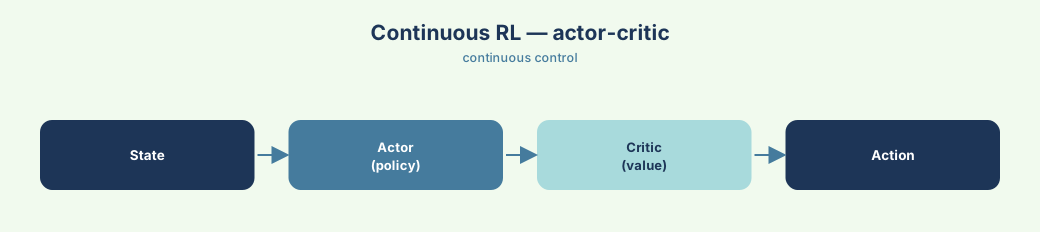
F-IV.28.0— Actor and critic. Brief: two modules: the "actor" proposes a continuous action, the "critic" evaluates; a robot/leg learning to walk in the background.
1. Definition and short history
Extends RL to continuous actions via actor-critic and policy gradient methods. Enabled learned locomotion and manipulation (2017+). The basis of control in robotics (see ch. 34).
2. Foundations
- Control theory — dynamical systems, stability.
- Optimization — policy gradient, trust region.
- Stochastic processes / MDP — stochastic policies, entropy.
- Physics — dynamics of the controlled body.
3. Algorithms and architectures
- Policy gradient — optimizes the policy directly.
- Actor-critic — actor (policy) + critic (value) reduce variance.
- Algorithms — PPO (stable, standard), SAC (maximum entropy), DDPG/TD3.
- Stability — trust region (PPO/TRPO), target networks.
4. Inputs
- Hardware: GPU + massive parallel simulation.
- Data: simulation rollouts; domain randomization for sim-to-real.
- Data structures: trajectories, advantage estimates.
- Systems: physics simulators (MuJoCo, Isaac), vectorized envs.
5. Specialized life cycle
| Stage | Specialization |
|---|---|
| 0 Problem | Continuous control (locomotion, manipulation), safety |
| 1 Data | Simulation (cheap) + real data (expensive); randomization |
| 2 EDA | State coverage, reward shaping |
| 3 Modeling | PPO/SAC; actor-critic architecture; reward |
| 4 Training | Parallel rollouts; sensitive hyperparameter tuning |
| 5 Evaluation | Reward, robustness, sim-to-real transfer |
| 5.5 Acceptance | Physical safety tests, actuation limits |
| 6 Production | Real-time policy on the robot; supervision |
| 7 Monitoring | Performance, anomalies, wear |
| 8 Retraining | New environments, fine-tune on the real one |
| 9 Governance | Physical safety, accountability (see ch. 34) |
6. Capabilities, modes, and modalities
Bodily-kinesthetic: locomotion, manipulation, industrial control, continuous optimization. The learning engine behind embodied robotics (ch. 34).
7. Limits, risks, and ethics
Sample-inefficient; sim-to-real gap; training instability; reward hacking; safety during exploration in the real world.
8. State of the art and examples
PPO (the "workhorse"), SAC; quadruped/humanoid locomotion, robotic hands; PPO is also the algorithm behind RLHF (ch. 29) — the bridge between control and LLM alignment.