Part I · 2 — The stages in detail
Each of the 11 stages, in the same mold: definition → inputs/outputs → activities → resources → sciences → mathematics. The consolidated matrices are in the next doc (
03-sciences-and-mathematics.kmd); here the focus is the narrative of each stage.
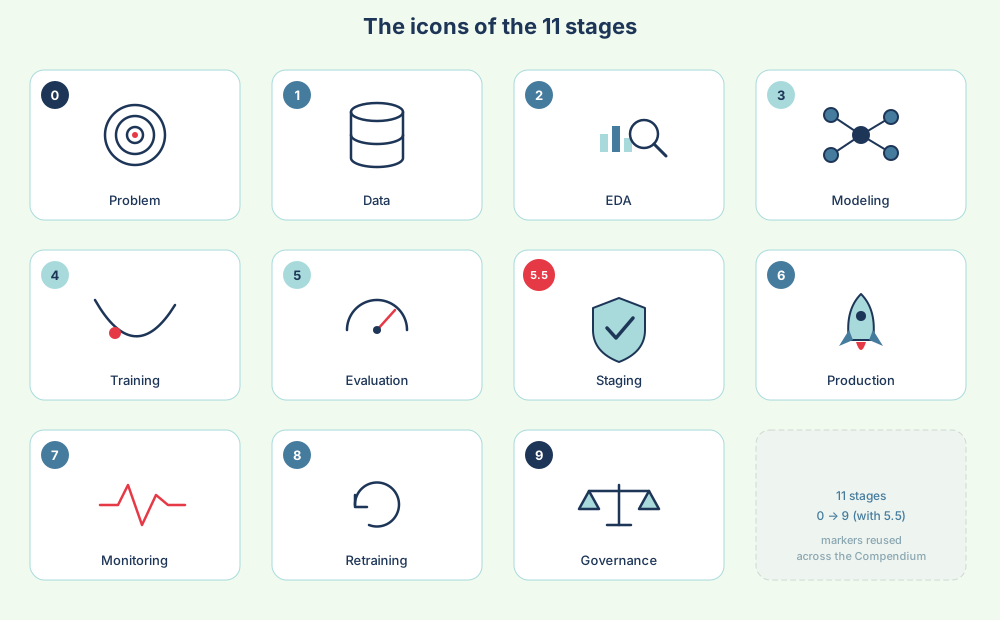
🎨 Figure
F-I.3— Icon sheet of the 11 stages. Brief: a set of 11 cohesive line icons (same stroke weight, Compendium palette), one per stage: target (0), crystal/database (1), magnifier+chart (2), network skeleton (3), gear+gradient (4), ruler+note (5), shield+check (5.5), rocketserver (6), sensoroscilloscope (7), circular arrow (8), scale+shield (9). Reused as markers throughout the whole Compendium.
Stage 0 — Problem definition
Definition. Translate a need (business, scientific, creative) into a well-posed AI task, with a success metric and an objective function.
- In: need, constraints, context. Out: problem spec +
metric + acceptance criterion.
- Activities: choose the task type (classification? regression? ranking?
generation? control?), define the target metric, map risks and feasibility.
- Resources: product-framing frameworks; no heavy machinery.
- Sciences: decision theory, economics (cost-benefit), *hilosophy/
ethics*(what should be built), psychology (user need), cognitive science (which intelligence capability to address).
- Mathematics: logic (formalizing the objective), combinatorics/complexity
(is the problem tractable?), game theory (are there incentives/adversaries?), statistics (choice of metric and baseline).
It is the least "mathematical" and most conceptual stage — and the one that most dooms projects when poorly done. A badly framed problem is not fixed with more GPU.
Stage 1 — Data collection and engineering
Definition. Acquire, label, clean, and transform the data that will be the AI's "knowledge".
- In: problem spec. Out: clean, versioned dataset, with features.
- Activities: acquisition (scraping, sensors, databases), labeling, cleaning,
feature engineering, deduplication, balancing, splits (trainvaltest).
- Resources:
- Hardware: CPU (ETL), massive storage (data lakes, object
storage, NVMe), network.
- Algorithms: sampling, hashing/dedup, outlier detection, tokenization
(BPE for text), feature extraction by modality.
- Data structures: tensors, columnar tables (Parquet/Arrow),
feature stores (B-trees/LSM-trees), embeddings tables.
- Systems: pipelines (Spark, Airflow, Kafka for streaming), data
versioning (DVC).
- Hardware: CPU (ETL), massive storage (data lakes, object
- Sciences: statistics (sampling, selection bias), linguistics
(text corpora), acousticsopticsDSP (audio/image signals), sociology (social bias in data), law (privacy, licensing).
- Mathematics: sampling and descriptive statistics, probability (bias,
representativeness), linear algebra (feature transformations), information theory (redundancy, compression).
A maxim of the field: "garbage in, garbage out". Data quality is the ceiling of model quality — hence the data-centric AI movement.
Stage 2 — Exploratory analysis (EDA)
Definition. Understand the real behavior of the data before modeling.
- In: dataset. Out: insights (distributions, correlations, anomalies)
that guide the modeling.
- Activities: visualization, descriptive statistics, correlations, detection of
outliers and leakage, balance and bias checks.
- Resources: CPU; analysis libraries (pandas, polars); tabular structures
and indexes; notebooks.
- Sciences: statistics (the protagonist), psychometrics (if there are
human labels), sociology (bias), the domain science (medicine, finance…).
- Mathematics: inferential statistics, correlation/covariance, *ypothesis
tests, dimensionality reduction (PCA* t-SNE/UMAP), information theory (entropy, mutual information).
Stage 3 — Modeling
Definition. Decide the shape of the intelligence: the architecture, the formulation of the objective, the inductive biases (priors) built in.
- In: EDA insights. Out: defined architecture + loss function +
initial hyperparameters.
- Activities: choose the model family, design the architecture, define the
loss, embed symmetries/priors, size capacity (parameters × data).
- Resources:
- Algorithms/architectures: Transformers, CNNs, diffusion, GANs/VAEs,
RNN/LSTM, GNNs, MoE, SSMs (Mamba) — the choice defines almost everything.
- Data structures: tensors, computational graph (DAG),
embeddings, sparse tensors (MoE/sparse attention).
- Systems: frameworks (PyTorch, JAX), compilers (XLA, Triton).
- Algorithms/architectures: Transformers, CNNs, diffusion, GANs/VAEs,
- Sciences: neuroscience (inspiration of the neuron, attention, memory),
physics (statistical mechanics → diffusion; Hopfield networks), cognitive science (reasoning architectures), biology/evolution (neuroevolution), linguistics (structure for NLP).
- Mathematics: linear algebra (representations, attention as a product of
matrices), group theory/symmetries (equivariance: CNN↔translation), geometry/topology (manifold hypothesis, latent spaces), information theory (objectives as KL/entropy), measure theory (continuous models).
It is the stage where the inspirations from neuroscience and physics weigh most — it is where the architecture ideas come from. It is also where the potential "intelligence" is decided: the architecture defines the hypothesis space that the model can represent.
Stage 4 — Training
Definition. Adjust the model's parameters to the data, minimizing the loss.
- In: architecture + dataset. Out: trained weights (+ checkpoints).
- Activities: forward/backward pass, iterative optimization, learning rate
scheduling, regularization, parallelization across many accelerators, checkpointing; post-training (SFT, RLHF/DPO, distillation).
- Resources:
- Hardware: GPU/TPU (Tensor Cores, systolic arrays) — the core;
HBM memory (the real bottleneck, not FLOPs); interconnect (NVLink, InfiniBand, all-reduce); storage for checkpoints; power/cooling.
- Algorithms: backpropagation, SGDAdamAdamW, schedulers,
gradient clipping, LoRA/QLoRA, quantization-aware training.
- Data structures: tensors, autodiff graph, sparse tensors (MoE).
- Systems: datatensorpipeline parallelism, FSDP/ZeRO (sharding),
orchestration (Ray, Slurm, Kubernetes), mixed precision (bf16/fp16).
- Hardware: GPU/TPU (Tensor Cores, systolic arrays) — the core;
- Sciences: electrical eng. (accelerators), materials science
(semiconductors), physics (thermodynamics/energy), learning psychology (conditioning → reinforcement), neuroscience (plasticity → weight updates).
- Mathematics: multivariable calculus (gradients, Jacobians, Hessians;
chain rule = backprop), optimization (the heart), stochastic processes (SGD as SDE, dropout), numerical linear algebra (GEMMs, stability), learning theory (bias-variance, generalization), information theory (cross-entropy/KL as loss).
The most hardware-intensive and continuous-mathematics-intensive stage. Where "training" costs from cents to hundreds of millions of dollars depending on scale.
Stage 5 — Model evaluation
Definition. Measure the statistical quality of the model on data it has not seen.
- In: trained weights. Out: metrics report + comparison with
baselines.
- Activities: measure on the test set, compare models, check fairness,
robustness and calibration, initial red teaming.
- Resources: GPU/CPU for evaluation inference; public and
private benchmarks; results data structures; dashboards.
- Sciences: psychometrics (test theory — the basis of benchmarks),
statistics, cognitive science (evaluating reasoning), sociology/ethics (bias and fairness).
- Mathematics: inferential statistics (confidence intervals,
significance), confusion matrix, ROC/AUC curves (integration), decision theory (thresholds), fairness metrics.
Crucial distinction: here the model is evaluated. The system around it is evaluated in stage 5.5. Confusing the two is a common error.
Stage 5.5 — Testing / Validation
Definition. Validate the whole system — code, API, integration, infra — before releasing it to the real world. It is software QA + business acceptance.
- In: evaluated model. Out: validated build, fit for production.
- Activities: unit/integration tests of the pipeline; API
contract/schema tests; validation in staging and *shadow* (real traffic without affecting the user); UAT (acceptance by stakeholders); adversarial and robustness tests; loadstress tests; regression; biascompliance checks.
- Resources: staging environments; load testers; testing frameworks; CI/CD;
feature flags; canary/shadow infra.
- Sciences: psychology/UX (UAT, usability), law (compliance),
software engineering, ergonomics.
- Mathematics: inferential statistics (power, sample size for
A/B and canary), sequential statistics (early stopping without inflating type I error), logic (specification and verification), combinatorics (coverage of cases), queueing theory (load tests), cryptography (security tests).
The 5.5 → 6 transition is gradual: canary release → A/B in production → rollback if it degrades. It is not an "on/off".
Stage 6 — Production / Deployment
Definition. Serve inferences efficiently, robustly, and at scale.
- In: validated build. Out: service in production answering
requests.
- Activities: serving, dynamic batching, caching (KV-cache),
quantization, autoscaling, routing (MoE), load balancing.
- Resources:
- Hardware: inference GPUTPUNPU, memory/HBM, network; edge for
on-device.
- Algorithms: sampling (top-k/p, temperature), speculative decoding,
paged attention (vLLM), quantization (int8/int4), pruning, LoRA.
- Data structures: KV-cache, vector indexes (HNSW) for RAG,
ring buffers
- Hardware: inference GPUTPUNPU, memory/HBM, network; edge for