Part IV · Ch. 07 — ASR (Speech Recognition)
Connectionist · Audio→text · Transformer / CTC. Transcribes speech into text. Card:
../02-types-of-ai/02-connectionist.kmd.
🎨 Figure
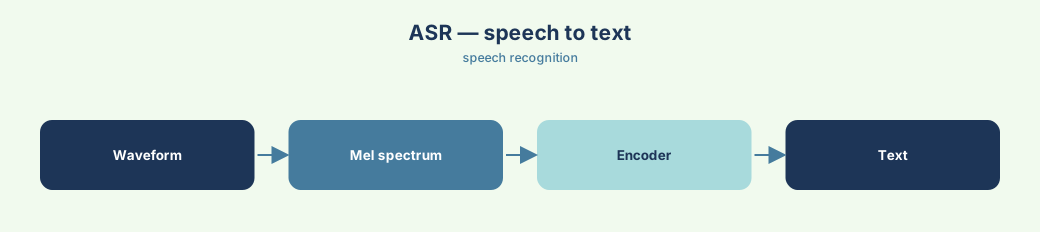
F-IV.7.0— From wave to text. Brief: waveform → mel spectrogram → encoder → transcribed text; temporal alignment indicated.
1. Definition and short history
Converts speech audio into text. Lineage: HMM-GMM (classical, see [ch. 20 — HMM]) → DeepSpeech (CTC) → wav2vec 2.0 (self-supervision) → Whisper (2022, robust and multilingual).
2. Foundations
- Acoustics / psychoacoustics — speech production and perception.
- Signal processing (DSP) — STFT, mel spectrogram, MFCC.
- Probability — sequence-to-sequence alignment (CTC, attention).
- Linguistics — phonetics, language models for rescoring.
3. Algorithms and architectures
- Front-end — mel spectrogram.
- Encoder — Transformer/Conformer (conv + attention).
- Alignment — CTC or encoder-decoder with attention.
- Self-supervision — wav2vec 2.0 pre-trains on unlabeled audio.
- Decoding — beam search with an optional language model.
4. Inputs
- Hardware: GPU (training); inference feasible on edge (small models).
- Data: audio + transcriptions (many languages, accents, noise).
- Data structures: spectrogram tensors, hypothesis lattices.
- Systems: audio pipelines; streaming for real time.
5. Specialized life cycle
| Stage | Specialization |
|---|---|
| 0 Problem | Languages, streaming vs batch, domain (medical/call center), latency |
| 1 Data | Audio+transcription, accent/noise diversity; alignment |
| 2 EDA | Distribution of languages, SNR, duration, label quality |
| 3 Modeling | CTC vs attention; Conformer; size; streaming |
| 4 Training | Self-supervised pre-training + fine-tune; augmentation (SpecAugment) |
| 5 Evaluation | WER (word error rate), robustness to noise/accent |
| 5.5 Acceptance | Tests per accent/language, bias, streaming latency |
| 6 Production | Low-latency streaming; punctuation; diarization |
| 7 Monitoring | WER in production, audio drift (new accents/channels) |
| 8 Retraining | Field data, new languages |
| 9 Governance | Voice privacy, consent, accent/gender bias |
6. Capabilities, modes and modalities
Auditory→linguistic: transcription, captioning, voice commands, assistant input; the base of voice agents (with TTS, ch. 08).
7. Limits, risks and ethics
Bias toward accents/low-resource languages; noise and overlapping speech; privacy of recordings; voice spoofing.
8. State of the art and examples
Whisper (multilingual, robust), Conformer; trend: unified streaming ASR with translation and with an LLM (audio→LLM directly).