Part V · 2 — Where it would make sense
"We don't use it today" is not "never". There are legitimate cases where the blockchain problem — consensus among parties that do not trust one another — does appear at Koder. This section maps them, and gives the filters for deciding with rigor.
2.1 The legitimate cases
Where there are multiple parties without a common root of trust and public verifiability is a requirement, blockchain stops being a regression and becomes a candidate:
| Case | Why blockchain enters |
|---|---|
| Cross-border B2C payments | settlement without a correspondent bank, 24/7, across jurisdictions. |
| Tokenized RWA / funds | fractionalizing and settling assets with public proof of ownership. |
| Decentralized identity | credentials the user controls and proves without depending on Koder. |
| Public audit log | proving to third parties that a record was not tampered with after the fact. |
| AI training-data provenance | a verifiable trail of dataset origin. |
| Anchored timestamping | proving a document existed on a date, without trusting Koder's clock. |
The common thread: they all involve proving something to someone who does not trust you. Where Koder is the only party and the only one that needs to trust, none of them apply.
2.2 The decision filters
Before introducing blockchain into any component, it passes through six filters — all must come back "yes":
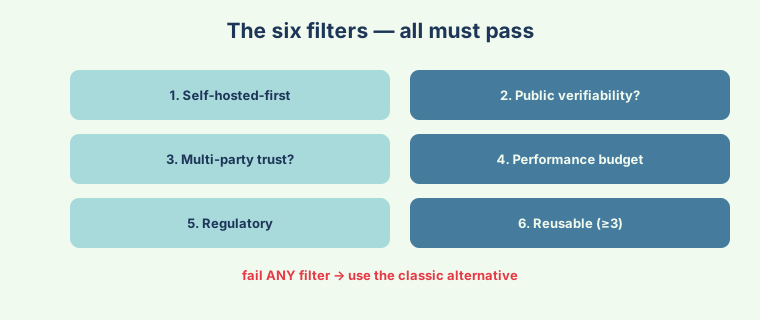
self-hosted-first— can it be solved with Koder technology or auditable OSSwithout depending on a third-party chain? If so, that is the preferred path.
- Is public verifiability necessary? — do third parties really need to verify
without trusting Koder? Or is an internal log enough?
- Is multi-party trust a requirement? — are there parties that do not trust one
another? If Koder is the sole authority, there is no consensus problem.
- Performance budget — does the case tolerate seconds of latency and low
throughput? (most of the Stack's paths do not).
- Regulatory — does the legal framing (of token, custody, jurisdiction) offset
the gain?
- Reusable cross-Stack? (
reuse-first) — do ≥3 real consumers justify an SDK,or is it an isolated case?
Failing any filter → blockchain is not justified; use the classic alternative. It is the same discipline as Part I: the tool follows the problem.
Dense reference: the seven detailed cases and the six filters in
15-koder-applied. Next: The alternatives — how to obtain verifiability and immutability without a blockchain, which is what Koder actually uses.