Part I · 1 — Aerial view of the blockchain
Before the hype and the jargon: what a blockchain is, what concrete problem it solves, and why it demands so much engineering. Spoiler — it's a database that gives up almost everything to gain one property: working without an owner.
1.1 What it is, in one sentence
A blockchain is a distributed, append-only ledger in which blocks of transactions are chained together by hashes and whose order is agreed upon by decentralized consensus — with no central authority.
Breaking down what each part carries:
- Append-only ledger — you only add; the past is never rewritten.
- Distributed — thousands of independent copies, with no master server.
- Chained by hashes — each block pins the previous one, making tampering
detectable (the cryptography underneath).
- Decentralized consensus — the rule that makes mutually trustless nodes
agree on what the next block is. It is the heart of the problem (Part II).
1.2 The problem it solves
Maintaining a shared record is trivial when there is an owner: a bank keeps everyone's balance because everyone trusts the bank. The blockchain attacks the ownerless case: how does a group of strangers, some possibly malicious, maintain a single, consistent record without anyone having to trust anyone?
The answer combines three pieces that hold each other up:
- Chained structure — makes history resistant to tampering.
- Consensus — makes the network agree on the order of events.
- Economic incentives — pay those who keep the network honest (native tokens).
Remove any one and the others collapse. That is why "blockchain" is not just a data structure — it is a socio-technical system.
1.3 The cost: blockchain vs. database
Solving the "ownerless" problem comes at an enormous performance price. A blockchain is, deliberately, a worse database at almost everything — except in the absence of a central point of trust:
| Aspect | Database | Blockchain |
|---|---|---|
| Trust | operator is the root | no root — consensus |
| Throughput | 1M+ TPS | 7 (Bitcoin) to ~100k (Solana) |
| Latency | milliseconds | seconds to minutes |
| Reversal | trivial | costly (requires a hard fork) |
| Audit | internal logs | public on-chain |
The right question before "use a blockchain": is there a trusted party that could simply keep a database? If so, a database is almost always better. A blockchain only pays off when the absence of a root of trust is a requirement, not a detail.
1.4 The ecosystem's layers
Like cryptography, blockchain is organized into layers — each one solving a limitation of the one below:
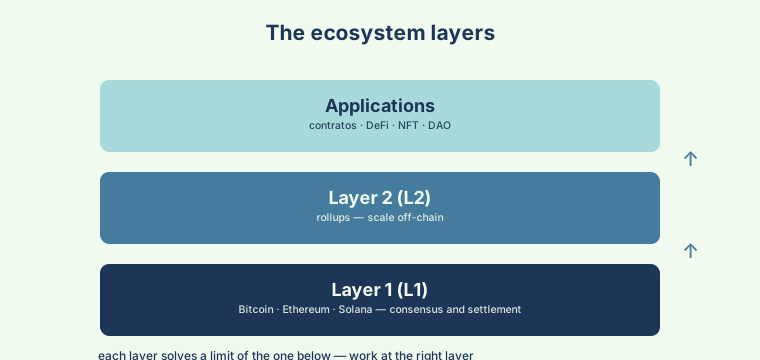
- Layer 1 (L1) — the base blockchain, which carries the consensus and the
final settlement: Bitcoin, Ethereum, Solana. Secure, but limited in throughput.
- Layer 2 (L2) — networks built on top of an L1 to scale (rollups),
processing transactions off-chain and settling in batches on the L1.
- Applications — what the user uses: smart contracts, DeFi, NFTs,
autonomous organizations (DAOs) — composed as "money legos".
The rule echoes Part I of Crypto: work at the right layer. Almost no user interacts with the consensus directly — they use an app on top of an L2 on top of an L1.
1.5 How this work is organized
This compendium has two layers (see the index):
- The narrated layer (Parts I–V) builds intuition in the natural order:
fundamentals → consensus → L1/L2 → DeFi → Koder posture.
- The reference layer (Part VIII) is the dense almanac: timeline,
L1/L2 catalogs, DeFi protocols, tokenomics, regulation, and incidents.
Part I continues in Concepts and the trilemma: how chaining guarantees immutability, the Byzantine generals problem, and the central trade-off that every blockchain faces.