Part II · 2 — Proof of Stake and BFT
What if influence were anchored in locked capital instead of burned energy? Proof of Stake does exactly that — and opened the door to BFT-style consensus with instant finality. It is the dominant paradigm of modern L1s.
2.1 Proof of Stake: betting capital
In Proof of Stake (PoS), influence comes from coin locked as collateral (stake). Instead of miners spending energy, validators deposit capital and are drawn to propose and attest blocks, with weight proportional to their stake.
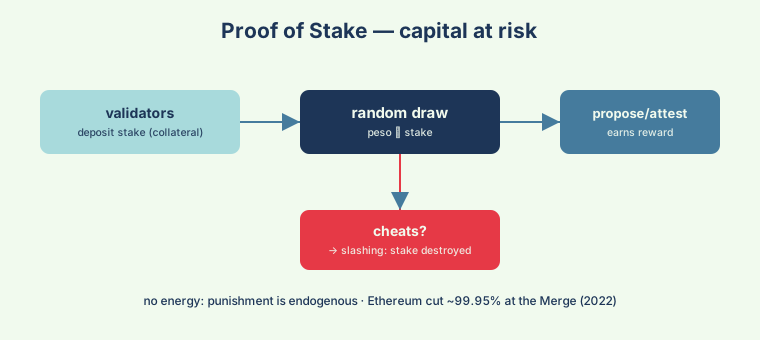
The incentive alignment shifts from "I spent energy, I don't want to waste it" to "my own capital is at risk":
- Attest honestly → reward proportional to stake.
- Cheat (sign two blocks, go offline) → slashing: part of the stake is
destroyed. The punishment is endogenous and automatic.
The big shift: security no longer costs physical energy. Ethereum migrated from PoW to PoS in the "Merge" (2022), cutting its consumption by ~99.95%.
2.2 Sybil solved another way
PoS solves the Sybil attack (section 1) without energy: creating a thousand fake validators doesn't help, because influence is proportional to the total locked capital, not the number of identities. Dominating the network requires acquiring a huge fraction of the coin — extremely expensive and self-destructive (attacking devalues your own stake).
2.3 BFT-style consensus: instant finality
PoS, with a known validator set, allows the use of classic BFT (Byzantine Fault Tolerance) algorithms that provide deterministic finality — a finalized block is never reverted (unlike PoW's probabilistic finality):
- Tendermint (Cosmos) — validators vote in rounds; with ⅔ of votes, the block
is final immediately. Tolerates up to ⅓ Byzantine validators.
- HotStuff (Aptos, Sui) — pipelined BFT, optimized for many validators.
- Variations: Algorand (secret cryptographic sortition), Avalanche (repeated
sampling), Ouroboros (Cardano, PoS with a formal security proof).
The classic trade-off: BFT gives fast finality but needs a reasonably small, known validator set (limiting decentralization) — back to the trilemma.
2.4 PoW vs PoS, side by side
| Proof of Work | Proof of Stake | |
|---|---|---|
| Scarce resource | energy/hardware | locked capital |
| Cost of attack | redo work (51%) | acquire ⅓–½ of the stake |
| Punishment | implicit (energy spent) | explicit (slashing) |
| Finality | probabilistic (slow) | fast; deterministic in BFT |
| Energy | very high | negligible |
| Main criticism | energy expenditure | "the rich get richer"; complexity |
There is no absolute winner: PoW trades energy for simplicity and proven robustness; PoS trades complexity for efficiency and fast finality. Most L1s launched after 2020 are PoS.
Dense reference: Tendermint, HotStuff, Algorand, Avalanche, Ouroboros, and slashing conditions in
03-consensus. Next: Finality and attacks — when a transaction is truly irreversible, and how consensus can be attacked.