Part II · 1 — The consensus problem and Proof of Work
How do thousands of anonymous nodes, with no mutual trust, agree on the same transaction ordering — without a coordinator and while resisting cheaters? Bitcoin's answer, Proof of Work, founded the industry. Here's why.
1.1 The problem, stated precisely
Part I introduced the Byzantine generals: agreeing despite malicious participants. In an open network, a second problem is added:
- Byzantine faults — nodes can lie, omit, or send contradictory messages.
- Sybil attack — since anyone can join without permission, an attacker can
create millions of fake identities and "win" any simple majority-of-nodes vote.
Voting by head doesn't work when creating heads is free. Every open blockchain's solution is to make influence expensive — anchoring it to a scarce real-world resource. How that resource is made scarce defines the consensus mechanism.
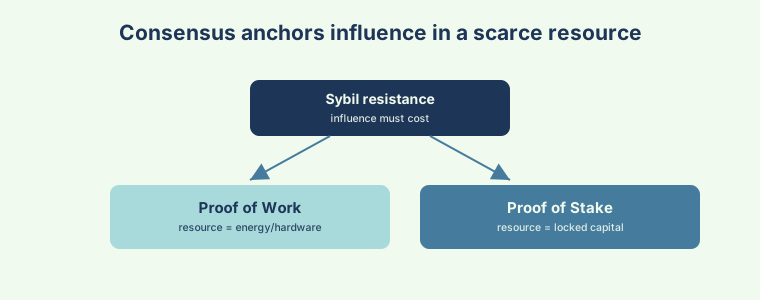
1.2 Proof of Work: spend energy to propose
Bitcoin's Proof of Work (PoW) (2008) anchors influence in computational work. To propose the next block, a miner must find a number (nonce) such that the hash of the block header falls below a target (difficulty). Since the hash is unpredictable, the only way is to try quadrillions of times — brute force.
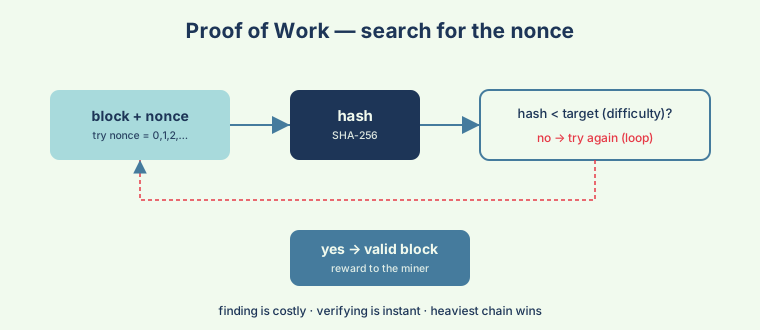
- Finding the solution is extremely expensive (energy, hardware);
verifying is instant (a single hash). This asymmetry is the heart of PoW.
- Difficulty self-adjusts to keep the inter-block interval constant
(~10 min in Bitcoin), no matter how much power enters the network.
- Whoever finds the block earns the reward (new coin + fees) — the incentive
that pays for the energy and aligns the miner with honesty.
1.3 The heaviest-chain rule (Nakamoto consensus)
With thousands mining, two valid blocks can appear almost simultaneously — a temporary fork. Which one wins? The rule: the chain with the most accumulated work (the "heaviest"). Honest miners always extend the heaviest tip; orphan blocks from the losing chain are discarded in a reorg.
This gives probabilistic finality: a block is never guaranteed final, but every block stacked on top makes reverting it exponentially more expensive (hence "wait for 6 confirmations"). Rewriting history would require redoing the work of all subsequent blocks faster than the honest network — the threshold of the 51% attack.
1.4 Strengths and the Achilles' heel
| Strength | Weakness |
|---|---|
| Proven simplicity and security (Bitcoin since 2009) | Enormous energy consumption (physical, by design) |
| Solid Sybil resistance (real cost) | Low throughput; slow finality (probabilistic) |
| No need for identity or prior stake | Tendency toward centralization in pools and ASICs |
PoW's energy expenditure — its very source of security — is also its biggest criticism. That's what drove the search for a scarcity anchor without burning energy: Proof of Stake, in the next section.
Dense reference: PoW algorithms, Nakamoto consensus, and the state of play in 2026 in
03-consensus. Next: Proof of Stake and BFT — anchoring influence in capital, not energy.