Part III · 3 — L2 and scaling
The trilemma says you can't have everything in a single layer. The modern answer: don't force the L1 to scale — move execution to a layer above and use the L1 only as a security anchor. This is the rollups thesis.
3.1 Why L2
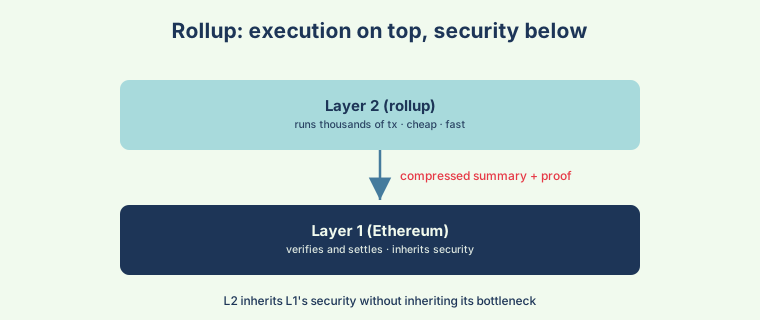
Increasing the L1's throughput (bigger, faster blocks) sacrifices decentralization — fewer people can run a node. The way out that preserves the trilemma is to separate the roles:
- Execution moves to a layer 2, which processes thousands of transactions
cheaply.
- Security and settlement stay on the L1, which only verifies the result.
The L2 inherits the L1's security without inheriting its bottleneck. It's the same principle as the layers in Part I: work at the right layer.
3.2 Rollups: compress and prove
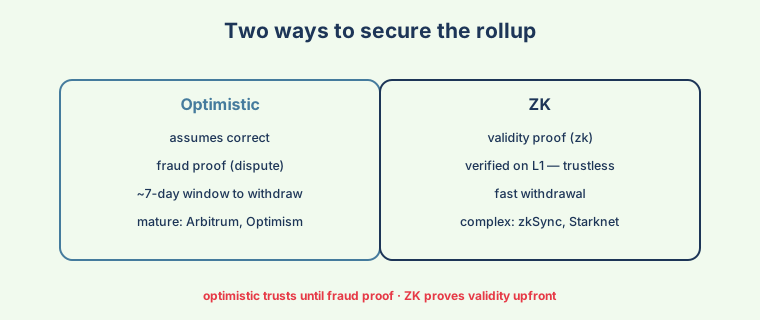
A rollup executes transactions off the L1 and publishes on the L1 a compressed summary of the result, plus a guarantee that it is correct. There are two ways to provide that guarantee — the central distinction among L2s:
| Optimistic rollup | ZK-rollup | |
|---|---|---|
| Guarantee | assumes correct; challengeable | mathematical proof of validity (zk) |
| Mechanism | fraud proof in a dispute window | validity proof verified on the L1 |
| Withdrawal to the L1 | slow (~7-day window) | fast (proof already verified) |
| Cost/maturity | simpler, mature (Arbitrum, Optimism) | more complex; proving is expensive (zkSync, Starknet) |
The optimistic one trusts until someone proves fraud; the ZK one asks for no trust — it delivers a proof that the execution was correct. Both depend on the L1 having the data available to verify.
3.3 Data availability and the modular thesis
For anyone to be able to verify (or challenge) the L2, the transaction data must be accessible — that's data availability (DA). It was the biggest cost of rollups, until EIP-4844 (2024) created blobs: cheap, temporary block space on Ethereum, dedicated to L2 data (cutting rollup fees by orders of magnitude).
This consolidated the modular thesis: instead of one chain doing everything, the system splits into specialized layers — execution (rollups), settlement (L1), consensus, and data availability (dedicated DA layers, like Celestia). Each evolves and scales separately. It's the same layered logic of cryptography and of the blockchain itself, taken to the top of the stack.
Dense reference: L2 taxonomy, optimistic/ZK rollups, state channels, validium, EIP-4844, and the modular/restaking thesis in
07-l2-scaling. End of Part III — we have the chains and how to scale them. Part IV — DeFi and applications (under construction) moves up to what gets built on top: financial contracts, NFTs, and RWA.