Part IV · 3 — Tokenomics, bridges and risks
A protocol can be brilliant and still collapse from the economics of its token, from a poorly designed bridge, or from a costly bug. This section closes Part IV with what decides an ecosystem's survival.
3.1 Tokenomics: the economics of the token
Tokenomics is the design of a token's economy — and it separates solid projects from schemes. The dimensions that matter:
- Supply — fixed total (scarce) or inflationary; and the emission curve
over time.
- Distribution — how much went to team/investors vs. community, and the
release schedule (vesting + cliff). Concentrated distribution with a near unlock is a red flag (future selling pressure).
- Utility / value capture — does the token do something (governance, fees,
staking) or only speculate? Tokens with no value capture tend to zero.
- Governance / DAOs — tokens that become votes in an autonomous
organization (DAO). The democratic ideal runs into reality: low participation and vote concentration among a few whales.
3.2 Bridges: the most dangerous link
Since no chain talks to another natively, bridges transfer value between chains — locking the asset on one end and minting an equivalent on the other. It is indispensable in a multi-chain world and, at the same time, the most expensive attack category in crypto history.
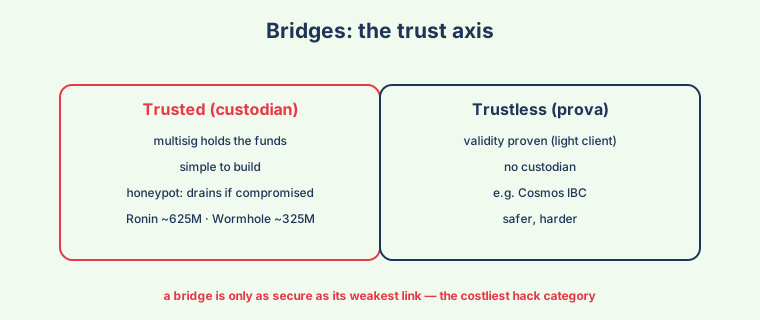
The axis is trust:
- Trusted — a custodian/multisig holds the locked funds. Simple, but it is a
honeypot: compromising the custodian drains the bridge (Ronin, ~US\(625M; Wormhole, ~US\)325M).
- Trustless — the validity of the transfer is proven cryptographically
(validity proofs, light clients like Cosmos's IBC). More secure, harder to build.
The practical rule: a bridge is only as secure as its weakest link, and billions have already been lost at that link.
3.3 The systemic risks
DeFi inherits the risks of "code is law" and amplifies them through composability:
| Risk | What it is |
|---|---|
| Contract exploit | a movable bug (reentrancy, overflow, flawed logic) drains funds — irreversible |
| Oracle manipulation | a fake price fools lending/AMM (often via flash loan) |
| Stablecoin depeg | the peg breaks; algorithmic ones can enter a death spiral (UST) |
| Rug pull | creators abandon/drain the project after attracting liquidity |
| Composability risk | the failure of one piece contaminates everything that depends on it |
The same composability that makes DeFi powerful makes it fragile: money legos stack risk alongside function. Auditing, formal verification and exposure limits are defenses — none of them eliminates the risk of moving real money with immutable code.
Dense reference: tokenomics, ve-tokenomics, governance/DAOs, bridge models, IBC/CCTP and the catalog of hacks in
12-tokenomics,11-bridges-interopand14-incidents. End of Part IV — what gets built and what threatens it. Part V — Blockchain at Koder *(under construction)* closes the arc with the Stack's posture: where verifiability is worth it, and where a database is better.