Part III · 2 — TLS: everything together
TLS is the protocol that protects the web — and the best example of how the primitives of Parts I–II fit together. In a single handshake there are key exchange, symmetric cipher, MAC, signature, and PKI, each in its role.
2.1 What TLS delivers
TLS (Transport Layer Security, successor to SSL) gives a connection three guarantees, over TCP:
- Confidentiality — no one on the path reads the data.
- Integrity + authenticity — no one alters the data without being detected.
- Server authentication (and optionally client authentication) — you really are talking
to
koder.dev, via the certificate chain from the previous section.
The version to use is TLS 1.3 (RFC 8446, 2018): faster, simpler, and one that removed all the fragile legacy algorithms of previous versions.
2.2 The 1.3 handshake, piece by piece
The TLS 1.3 handshake completes in one round trip (1-RTT). See where each primitive enters:
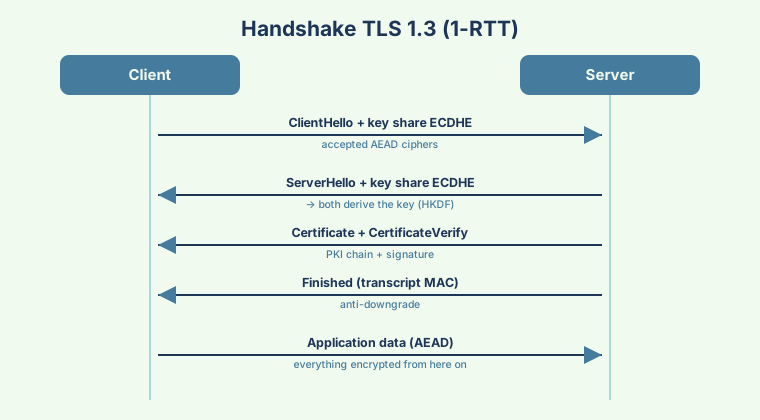
- ClientHello — the client sends supported versions, the AEAD ciphers it accepts,
and its public ECDHE share (an ephemeral key; Part II).
- ServerHello — the server picks the cipher, sends its ECDHE share —
and from here on both already derive the shared secret (ECDHE) and, via HKDF (Part II), the symmetric session keys.
- Certificate + CertificateVerify — the server sends its *ertificate
chain (PKI) and signs*the handshake with its private key (Ed25519/RSA-PSS). This is what proves "I really am
koder.dev" — it is not enough to have done the ECDHE, you must sign. - Finished — a MAC over the entire transcript, on both sides, ensures
that no one tampered with the handshake messages (anti-downgrade).
- Application data — from here on, everything encrypted with AEAD
(AES-GCM / ChaCha20-Poly1305) using the derived keys.
Notice: the ECDHE gives forward secrecy and the secrecy; the signature over the certificate gives the identity. Both are necessary — confidentiality without authentication would be a secure tunnel to an impostor.
2.3 Why each piece exists
| Handshake piece | Primitive | Without it… |
|---|---|---|
| ClientHello/ServerHello key share | ECDHE (ephemeral asymmetric) | no session secret; no forward secrecy. |
| Key derivation | HKDF | no symmetric keys from the secret. |
| Certificate + Verify | signature + PKI | a MITM impersonates the server. |
| Finished | MAC over the transcript | downgrade to a weak cipher. |
| Application data | AEAD | no confidentiality/integrity of the data. |
It is the thesis of Part I in action: work at the protocol layer (TLS), which orchestrates the primitives — never build this by hand.
2.4 TLS's cousins
The same fit reappears in other secure-transport protocols:
- SSH — remote access; key exchange + host keys (trust on
first use, TOFU) + session cipher.
- WireGuard — a modern, minimalist VPN, based on the Noise framework: only
curves (Curve25519), ChaCha20-Poly1305, and BLAKE2 — without the zoo of IPsec options. The recommended replacement for IPsec/IKE when possible.
- QUIC — the transport of the modern web (HTTP/3) with the TLS 1.3 handshake
built in.
Dense reference: the complete handshake, the historical failures (BEAST, Heartbleed, downgrade), SSH, IPsec, and WireGuard are in
07-protocols. Next: Messaging and Signal — where trust is not in a server, but end-to-end between people.