Part III · 1 — Trust and PKI
The primitives guarantee that a message came from whoever holds a certain key. But how do you know that key really belongs to your bank, and not to an impostor? That is the trust problem — what the protocols resolve before any byte travels.
1.1 The problem still to solve
Part II showed how two strangers combine a secret (ECDHE) and prove authorship (signatures). But there is a hole: when Alice receives a public key saying "I am the bank", nothing in the math guarantees it is true. A man-in-the-middle attacker can deliver their own key.
Exchanging keys securely is solved; binding a key to an identity is what is missing. There are two historical answers:
- Hierarchical (PKI) — trusted authorities attest who owns which
key. It is the web's model.
- Web of trust — users themselves sign each other's
keys (PGP). More decentralized, but hard to scale.
1.2 Forward secrecy: why ephemeral keys
Before identity, a property of the key agreement itself: the exchange must use ephemeral keys (ECDHE — the final "E"), discarded after the session.
The reason is forward secrecy: if the server's long-term private key leaks tomorrow, all the traffic recorded in the past stays unreadable — because the session key that encrypted it no longer exists and cannot be re-derived. Without ephemerality (the old RSA key transport), a future leak opens the entire history. That is why TLS 1.3 only allows ephemeral exchange.
1.3 Certificates: a signed identity
A certificate is a document that says "this public key belongs to koder.dev" — signed by the private key of an authority. It is just a digital signature (Part II) applied to (identity + public key +
validity).
If you trust the authority's public key, you can verify the signature and then trust the binding. Trust is delegated.
1.4 The chain of trust
Nobody trusts a single authority for everything. PKI forms a chain:
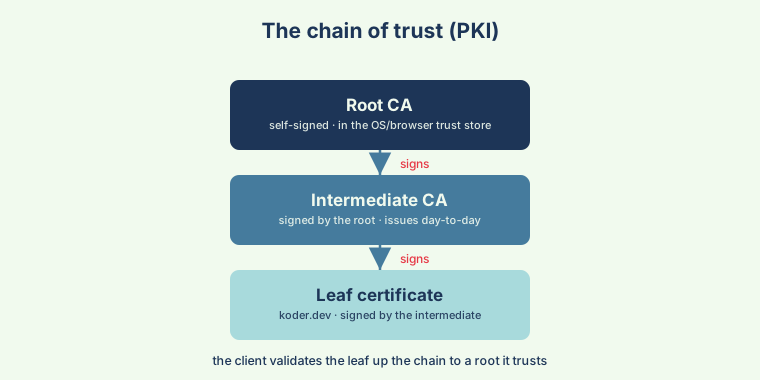
- Root CA — a root authority whose certificate is self-signed and comes
pre-installed in the operating system / browser (the trust store). It is the anchor.
- Intermediate CA — signed by the root; it is what actually issues day to
day (the root stays offline, protected).
- Leaf certificate — the site's (
koder.dev), signed by the intermediate.
On connecting, the server sends leaf + intermediate; the client validates the chain up to a root it trusts, checking signature, validity, revocation, and whether the name matches (SAN). A break in any link ⇒ the padlock does not close.
Where Koder fits in: Koder operates its own DNS and issuance (Koder Herald) and the identity plane (Koder ID). All communication is HTTPS only with a 301 redirect (
policies/security.kmd) — the web's chain of trust is a prerequisite, not optional.
1.5 Revocation: when trust expires early
Certificates have a validity period, but sometimes a key leaks before it expires. Revocation mechanisms:
- CRL (Certificate Revocation List) — lists of revoked certificates; heavy.
- OCSP — online status query; with stapling, the server attaches the fresh
proof, avoiding leaking to the validator which site you visit.
- Short validity — the modern trend (certificates of ~90 days, ACME/
Let's Encrypt) makes revocation almost unnecessary: the problem expires soon.
Dense reference: the validation chain, OCSP/CRL, and the history of compromised CAs are in
07-protocols. Next: TLS — where the key exchange, the symmetric cipher, the signature, and PKI come together in a single handshake.